Rough Terrain Crane OEM Risks to Check Early
Choosing a rough terrain crane OEM too quickly can expose projects to hidden compliance gaps, weak parts support, and costly uptime risks. For project managers and engineering leads, early due diligence is essential to verify build quality, certification, service capability, and lifecycle value before contracts are signed. This guide highlights the key rough terrain crane OEM risks to assess early so procurement decisions stay technically sound and commercially secure.
Why Early OEM Screening Matters More Than the Crane Brochure
The core search intent behind rough terrain crane OEM is practical supplier evaluation, not product curiosity. Project managers usually want to reduce procurement risk before a crane enters a tender, fleet plan, or lifting package.
In most cases, readers are not asking whether a rough terrain crane can perform. They are asking whether a specific OEM can support safe operation, certification, maintenance, uptime, and residual value under real project conditions.
That is why early screening matters. A technically impressive unit can still become a costly asset if the manufacturer lacks regional service coverage, traceable quality systems, or dependable parts support.
For engineering-led procurement, the right decision is rarely the lowest upfront price. The better decision is the OEM with verifiable compliance, predictable lifecycle cost, strong field support, and a product platform suited to actual duty cycles.
What Project Managers Usually Need to Confirm First
Before comparing boom length, lift charts, or cabin options, project leaders usually need answers to five business-critical questions. Can the OEM meet local compliance rules, deliver on schedule, support the machine in the field, supply parts quickly, and protect uptime?
These questions are more valuable than generic marketing claims because they connect directly to project execution risk. Delays, lifting incidents, unplanned downtime, and weak aftermarket support can all damage budgets and contractor performance.
For this reason, rough terrain crane OEM evaluation should begin with operational reliability and commercial accountability. Technical specifications matter, but they only matter when backed by service infrastructure and proven manufacturing discipline.
Risk 1: Compliance Claims That Do Not Match Your Project Jurisdiction
One of the earliest risks to check is whether the OEM’s compliance package aligns with your project location. A crane acceptable in one market may require additional certification, documentation, or modifications in another.
Project managers should verify machine conformity against applicable standards, emissions rules, roadability requirements, lifting safety regulations, and operator protection expectations. Do not assume global branding means universal regulatory readiness.
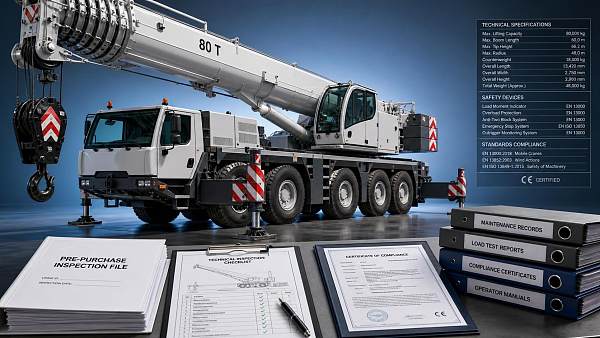
Ask for complete documentation rather than summary statements. This includes load charts, test certificates, welding procedures where relevant, axle and tire specifications, emissions compliance records, and evidence of third-party inspection where required.
If the OEM relies heavily on distributor interpretation for compliance, risk increases. The safest suppliers can explain exactly how each crane configuration satisfies the target market’s legal and site-specific requirements.
For mining, infrastructure, and EPC environments, weak documentation creates approval delays. Even when equipment eventually passes inspection, the process can absorb engineering time and disrupt mobilization schedules.
Risk 2: Build Quality That Looks Strong on Paper but Fails in Harsh Duty Cycles
Not every rough terrain crane OEM builds for the same operating reality. Some products are well suited to intermittent lifting on prepared sites, while others are engineered for severe terrain, high utilization, heat, dust, and remote support conditions.
Brochures often highlight maximum capacity and boom geometry, but project teams should examine the machine as a whole system. Structural integrity, hydraulic stability, chassis durability, slew system reliability, and electrical protection all affect real performance.
Ask the OEM for duty-cycle references that resemble your application. A crane working in a refinery shutdown, open-pit support operation, or remote civil package may face very different stress levels than one serving a standard urban construction site.
It is also worth checking component sourcing. Engines, hydraulic pumps, transmissions, sensors, and control systems from established suppliers can make future maintenance easier, especially in international projects with mixed fleet environments.
Another useful indicator is failure history transparency. Strong OEMs can discuss known wear points, design updates, service bulletins, and field improvements without becoming defensive. That openness usually signals mature product support and engineering accountability.
Risk 3: Weak Spare Parts Availability and Long Lead Times
For most project managers, spare parts support is one of the most decisive rough terrain crane OEM risks. A machine can be competitively priced and technically capable, yet still become operationally expensive if parts are slow or unpredictable.
Early due diligence should focus on local and regional stockholding, typical lead times for critical components, emergency shipment processes, and the OEM’s authority over distributor inventory planning. Parts support should be measured, not assumed.
Ask specifically about high-risk categories such as hydraulic seals, hose assemblies, electrical modules, boom wear items, filters, brake components, tires, and operator interface parts. These items often determine whether downtime lasts hours or weeks.
Project teams should also ask whether parts catalogs are digitized, whether serial-number traceability is strong, and whether superseded part numbers are clearly managed. Confusion in parts identification is a common source of maintenance delay.
If a supplier cannot produce data on fill rates, average dispatch times, or regional warehouse coverage, the crane may carry hidden lifecycle risk. For remote sites, that risk can become larger than the initial purchase discount.
Risk 4: Service Network Gaps That Shift Too Much Burden to the Buyer
A rough terrain crane OEM should not be judged only by factory quality. It should also be judged by field response capability. The most expensive failure is often not a broken component, but a slow or ineffective service intervention.
Project managers should map the actual service chain before award. Who performs commissioning, warranty repairs, scheduled maintenance, load testing support, and major troubleshooting? Is support delivered by the OEM itself or entirely by third parties?
It is important to verify technician competence, training frequency, and access to diagnostic tools. A distributor may be strong in general equipment service yet still weak in crane-specific electrical, hydraulic, or load-moment system troubleshooting.
Also assess response commitments in writing. Verbal promises about rapid mobilization are less useful than documented service-level expectations covering callout time, troubleshooting escalation, and access to engineering support.
For projects in mining regions, frontier markets, or geographically isolated sites, field support planning should be part of procurement negotiation. In some cases, the right OEM is the one willing to create a site stocking plan or embedded service arrangement.
Risk 5: Warranty Terms That Sound Broad but Offer Limited Practical Protection
Warranty language can create a false sense of security if buyers only review the headline term. A two-year warranty is not automatically stronger than a one-year warranty if exclusions, approval processes, and labor coverage are restrictive.
Review what is actually covered, how claims are approved, and whether travel, diagnostics, freight, or third-party labor are included. Clarify how wear items are defined, and whether recurring faults trigger root-cause engineering review.
Project managers should also ask for examples of recent warranty cases. The way an OEM handles real failures often says more than the written warranty document. Strong suppliers resolve claims quickly and transparently because they value fleet reputation.
Another important point is whether warranty remains valid under severe-duty applications. If the crane will operate in high heat, dust, remote mining support, or continuous heavy use, make sure those operating conditions are not quietly excluded.
Risk 6: Poor Visibility Into Total Cost of Ownership
Procurement mistakes often happen when buyers compare acquisition price more closely than lifecycle economics. The more useful question is not just what the crane costs to buy, but what it costs to keep productive over several years.
Total cost of ownership should include fuel use, routine maintenance intervals, tire replacement frequency, expected wear-part consumption, service labor cost, transport constraints, operator training needs, and probable downtime exposure.
Residual value also matters. Some rough terrain crane OEM brands retain stronger resale demand because they are trusted in the secondary market and supported by stable parts channels. That can materially improve asset economics at fleet renewal time.
Project teams should request a lifecycle model rather than a simple quotation. Even a high-level model helps reveal whether a lower-priced machine is likely to generate higher support cost and reduced utilization later.
For capital-intensive contractors, this analysis also improves internal approval. Finance and operations leaders usually support procurement decisions more confidently when cost assumptions are transparent and tied to fleet reality.
Risk 7: OEMs Without Strong Reference Performance in Similar Operating Environments
One of the best ways to reduce uncertainty is to ask where the crane has already worked under comparable conditions. Similar terrain, climate, utilization intensity, operator skill level, and maintenance infrastructure all make references more meaningful.
Generic customer lists are less useful than targeted references. If your application involves quarry support, mine maintenance, remote infrastructure, or shutdown lifting, ask for fleet performance examples from those specific environments.
References should not only confirm that units were delivered. They should confirm uptime, service response quality, recurring faults, parts availability, and whether the OEM remained engaged after commissioning.
If possible, ask for evidence of repeat orders. Repeat purchases usually signal that the OEM met expectations across technical performance, support quality, and commercial reliability.
How to Structure a Better Rough Terrain Crane OEM Evaluation Process
The most effective evaluation process combines technical review, commercial review, and field support validation. That means procurement, engineering, HSE, maintenance, and operations should all contribute to supplier assessment.
Start with a qualification checklist. Include compliance documentation, manufacturing quality systems, key component brands, service network map, regional parts availability, warranty structure, delivery lead time, and relevant project references.
Then move to risk-weighted scoring. For many projects, compliance, service readiness, and parts support should carry more weight than optional features. This prevents attractive specifications from overshadowing practical execution risk.
Site visits or factory audits can be justified for larger fleet purchases or strategic supplier onboarding. Even a limited audit can reveal process discipline, testing rigor, and the maturity of quality assurance systems.
Finally, build support obligations into the contract. Delivery terms, commissioning responsibilities, documentation completeness, technician availability, spare parts packages, and warranty response expectations should all be commercially enforceable.
Practical Questions to Ask Before Signing
Ask the OEM to identify every certification and document required for your target jurisdiction. Request confirmation of what is standard, what is optional, and what may require engineering changes or third-party approval.
Ask for lead times on critical spare parts, not just routine consumables. Request the location of stocked inventory and evidence of recent dispatch performance in your region or a similar operating geography.
Ask who will service the crane during warranty and beyond. Confirm technician training level, availability of crane-specific diagnostics, and escalation routes if the local service team cannot resolve a fault.
Ask for reference projects with similar utilization intensity. Where possible, speak directly with fleet or maintenance managers rather than relying only on sales representatives or polished case studies.
Ask for a five-year ownership view, including maintenance assumptions and likely wear items. If the OEM cannot support that conversation with confidence, the commercial picture may still be incomplete.
Conclusion: The Best OEM Choice Is the One That Lowers Execution Risk
For project managers and engineering leads, rough terrain crane OEM selection is fundamentally a risk decision. The real objective is not only to secure lifting capacity, but to protect compliance, schedule certainty, uptime, and long-term asset value.
The strongest OEMs distinguish themselves early. They provide clear documentation, realistic lead times, dependable service structures, transparent warranty handling, and credible reference performance in demanding environments.
When early due diligence is done well, procurement teams avoid being trapped by hidden support gaps or weak lifecycle economics. They choose a crane partner, not just a machine supplier.
In high-value industrial projects, that distinction matters. A disciplined rough terrain crane OEM review can prevent avoidable downtime, reduce commercial exposure, and support safer, more predictable project delivery.
Recommended News
 Aug 25, 2026How to check technical compliance before buying mobile cranesTechnical compliance is the first check before buying mobile cranes. Learn how to verify certifications, load charts, inspections, and road legality to reduce risk and buy with confidence.
 Jun 12, 2026Advanced Crane Control Systems: Key Features That Reduce Lift RiskAdvanced crane control systems reduce lift risk with anti-sway, load monitoring, zoning, and diagnostics—helping mining and heavy industry teams improve safety, precision, and compliance.
 May 24, 2026Stability Control Algorithms in Cranes: How to Judge Real-World SafetyStability control algorithms in cranes: learn how to judge real-world safety through sensor reliability, fail-safe logic, wind and load response, and validation evidence before approval or purchase.
 May 23, 2026Hydraulic Pump Flow Rate Metrics That Matter in Mobile Crane SelectionHydraulic pump flow rate metrics guide smarter mobile crane selection by revealing real lifting speed, multi-function control, efficiency, and lifecycle cost before you buy.