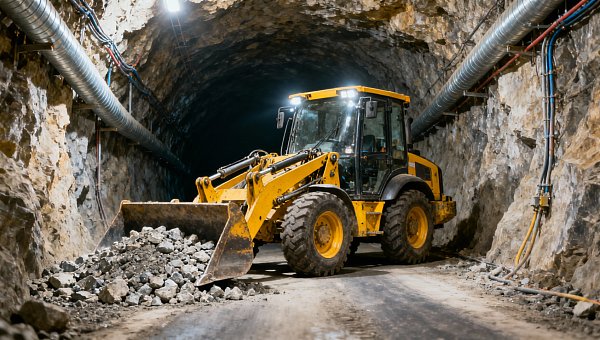
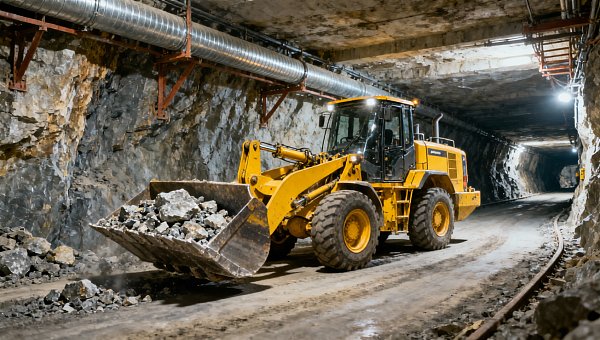
Underground Tunnel Loaders: Planning Muck Removal in Narrow Headings
The blast is complete, the heading has been cleared for re-entry, and the next excavation cycle is waiting on one thing: getting the muck out. In a narrow tunnel, that task can consume more time than the excavation team expects. A loader that looks productive on a specification sheet may struggle with tight bends, uneven floors, congested services, or a discharge point that moves farther away every week.
Selecting an underground tunnel loader therefore means planning a working system, not simply buying bucket capacity. Project managers need to connect machine geometry, muck characteristics, haulage arrangements, ventilation, and maintenance access to the actual excavation schedule. The useful question is not “Which loader is largest?” but “Which arrangement can reliably clear this heading within the available window?”
Start with the mucking window, not the equipment catalogue
Work backward from the next activity that requires access to the face. In drill-and-blast tunnelling, mucking shares the cycle with drilling, charging, ventilation clearance, examination, scaling, and ground support. Their sequence depends on the approved excavation method and ground conditions; loader access must never assume that required inspections or support can be postponed.
Establish how much material must be removed and how long the loader can genuinely operate. Breaks, access restrictions, inspections, truck changes, and service work reduce the usable window. If the schedule allows four hours for muck removal, four hours of uninterrupted loading is rarely a defensible planning assumption.
Estimate loose muck volume from the excavated cross-sectional area, advance length, and an appropriate swell factor. Include expected overbreak separately rather than hiding it inside a generous productivity allowance. Use project measurements to refine these assumptions as excavation progresses.
- Excavation quantity: planned advance, actual profile, and likely overbreak.
- Material condition: fragmentation, loose bulk density, moisture, abrasiveness, and oversize frequency.
- Operating window: time available after mandatory clearance and preparation activities.
- Discharge arrangement: direct haul to a dump, transfer to trucks, or feeding a compatible muck-handling system.
This establishes the required average removal rate. It also reveals whether the proposed loader is being asked to compensate for a bottleneck elsewhere, such as insufficient truck availability or a restricted tipping area.
Can the underground tunnel loader work through the entire route?
Machine width and height are only the beginning of a clearance review. The usable tunnel envelope changes with support, ventilation ducting, drainage pipes, cable brackets, temporary storage, and local floor conditions. A machine that fits through the portal may still be unable to load, articulate, or discharge safely at the face.
Check the swept envelope, not just straight-line clearance
Overlay the proposed loader’s operating geometry on surveyed tunnel sections and junction layouts. Obtain manufacturer drawings covering articulation, bucket positions, turning radii, and discharge height. Check the full swept path: the bucket and rear frame can approach different parts of the tunnel during a turn.
Allow for floor irregularities, tyre movement, and operating tolerances. Clearance is not simply the difference between nominal tunnel width and machine width. Pedestrian separation, emergency access, and protective structures must also follow the site risk assessment and applicable requirements.
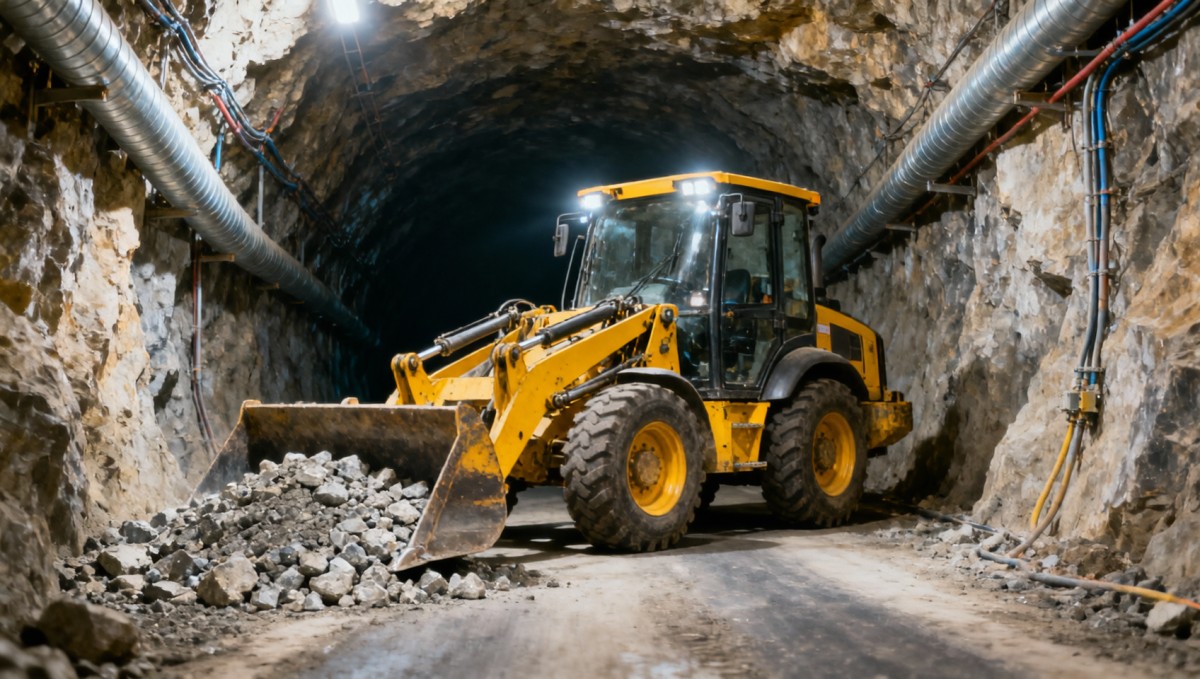
A useful route drawing shows the face, tightest supported section, bends, passing bays, service crossings, and discharge point together. Marking these constraints on one plan often exposes a problem that separate equipment and civil drawings miss.
Treat the floor as part of the machine specification
Gradient, rolling resistance, water, and loose rock affect travel speed, traction, braking, and component wear. Check laden and unladen performance against the actual route, including stopping and holding capability on grades. Catalogue travel speeds should not be inserted directly into a production model.
Also examine where the loader will approach the muck pile. Restricted approach angles can make bucket filling inconsistent. Poor drainage or persistent spillage may reduce production more than a modest difference in rated engine power.
Translate bucket capacity into achievable removal time
A rated bucket volume is not a guaranteed payload. Effective loading depends on bucket fill, loose bulk density, fragmentation, and the machine’s rated load limit. Dense material may reach the payload limit before the bucket is volumetrically full; poorly fragmented muck may produce low fills and longer digging times.
For preliminary planning, use:
Effective volume per trip = the lower of bucket volume × fill factor, or rated payload ÷ loose bulk density.
Then build the cycle from observable activities: loading, loaded travel, positioning, dumping, empty return, and routine manoeuvring. Model significant interruptions separately so they remain visible.
Consider an illustrative heading with a 24 m² excavated section and a 3 m advance. Before overbreak, that represents 72 m³ in place. An assumed swell factor of 1.5 gives 108 m³ of loose muck. If a 3 m³ bucket achieves an average 80% fill, each trip moves 2.4 m³, provided the rated payload is not exceeded.
That requires approximately 45 trips. At a six-minute average cycle, the basic work takes 270 minutes. If only 75% of the mucking window is available for these cycles, elapsed removal time becomes approximately 360 minutes. These are planning assumptions, not equipment performance claims, but they show why a seemingly adequate bucket may miss a four-hour window.
Avoid counting the same delay twice. If measured cycle times already include ordinary truck waits, adding another allowance for those waits will distort the estimate. Keep each loss category explicit, and test sensitivity to haul distance, fill factor, and oversize handling.
Decide where loading ends and haulage begins
A load-haul-dump machine can serve a short route effectively. As the heading advances, however, increasing travel time leaves the bucket away from the face for longer. That is the point at which the project should reassess direct haul rather than automatically demand a larger loader.
Truck-assisted haulage is not automatically faster. A truck that blocks the loader’s approach or waits in the only passing area can erase the benefit. Size the fleet around loading time, haul-and-return time, and traffic rules, then check whether the loader waits for trucks or trucks queue for the loader.
Plan transfer locations as part of the excavation development strategy. A discharge point that works during early advances may become inefficient later. Set a review trigger based on measured cycle time or haul distance so relocation is considered before mucking becomes the critical-path problem.
Diesel or battery-electric: compare the whole shift
Powertrain selection should follow the route and duty cycle, not a general preference for one technology. Both diesel and battery-electric underground loaders need suitable operating infrastructure, competent maintenance support, and a site-specific safety assessment.
Diesel equipment may suit projects with established fuel logistics and limited electrical infrastructure. Its emissions and heat must be accounted for in ventilation design, alongside altitude, ambient conditions, fuel quality, and aftertreatment maintenance. Required airflow depends on applicable rules and the project’s engineering assessment—not one universal airflow-per-kilowatt assumption.
Battery-electric equipment removes diesel exhaust at the point of use and can reduce some ventilation loads. It does not eliminate ventilation demand: dust, blasting fumes, heat, and other underground activities remain relevant. Charging infrastructure, electrical capacity, battery temperature management, emergency response, and equipment recovery arrangements need to be designed into the system.
For a battery option, request an energy assessment covering loaded gradients, repeated acceleration, digging effort, auxiliary loads, and battery degradation. Establish whether the machine can complete the planned mucking window, where charging or swapping occurs, and what happens when charging equipment is unavailable.
Compare both options using the same production requirement. A purchase-price comparison alone misses ventilation energy, infrastructure changes, fuel or electricity, replacement components, maintenance labour, and the cost of interrupted excavation.
Protect availability where access is hardest
In a narrow heading, a disabled machine can become both a production loss and a route obstruction. Before procurement, ask how technicians will reach service points underground and how a failed loader will be recovered without exposing workers to uncontrolled movement or restricted escape routes.
Maintenance access deserves a physical review. Confirm space for inspections, isolation, tyre work, hose replacement, and major component handling in designated service areas. Examine parts support and repair capability for the exact machine configuration; a common model name does not guarantee local availability of its underground-specific components.
Several operating controls belong in the muck-removal plan:
- Defined exclusion zones and pedestrian segregation during loader movements.
- Communication procedures at blind bends, transfer points, and shared routes.
- Visibility aids appropriate to the heading, with cameras and detection systems supplementing—not replacing—traffic controls.
- Site-approved handling procedures for oversize material, suspect misfires, and unstable muck piles.
- Recovery, isolation, and fire-response arrangements suited to the selected powertrain.
These controls should be checked against the governing jurisdiction and relevant equipment requirements. ISO references, AS/NZS requirements, or mining legislation may be applicable, but none should be treated as a substitute for confirming the project’s actual legal and technical obligations.
Specify evidence that procurement can compare
G-MRH’s emphasis on technical benchmarking and lifecycle scrutiny is especially relevant when several machines appear similar on paper. A useful comparison gives every supplier the same tunnel geometry, route profile, material assumptions, operating window, and discharge arrangement. Otherwise, their productivity estimates may describe different jobs.
Request documented operating envelopes, payload limits, grade performance, service requirements, and the assumptions behind cycle-time estimates. Separate verified specifications from predicted site performance. For unfamiliar duty cycles, a site trial or a validated simulation can provide stronger evidence than a generic production figure.
During commissioning, record loading time, travel time, waiting, bucket fill, energy or fuel use, and downtime by cause. Compare median performance with slow cycles as well as the best runs. Excavation schedules are often disrupted by recurring difficult cycles, not by the machine’s peak capability.
The right underground tunnel loader is the one that fits the working envelope and supports a dependable excavation rhythm. When route design, haulage balance, power infrastructure, and maintenance access are planned together, muck removal becomes a manageable part of the programme rather than a nightly negotiation with lost time.
Recommended News
 Oct 16, 2026Underground Tunnel Loaders: Planning Muck Removal in Narrow HeadingsChoose the right underground tunnel loader for narrow headings. Explore clearance, haulage, cycle times, and power options to reduce delays and plan reliable muck removal.
 Oct 14, 2026Choosing an Underground Loader: Payload, Clearance, and Ventilation NeedsChoose the right underground loader by comparing payload, clearance, and ventilation needs. Discover how to boost mine productivity and avoid costly sizing mistakes.
 Sep 07, 2026How automation is changing job roles in underground miningExplore the impact of automation on mine jobs, from remote operations and predictive maintenance to new skills, safer workflows, and workforce planning.
 Sep 02, 2026How to use bucket fill factor calculation to estimate loader productivityBucket fill factor calculation made practical: learn to estimate loader productivity with real payload, loose density, cycle time, and efficiency data.