Choosing an Underground Loader: Payload, Clearance, and Ventilation Needs
An underground loader should be sized to the tonnes it can move through the actual mine layout—not simply to its rated payload. A larger machine is only an improvement if it can fill its bucket effectively, negotiate the tightest operating sections, and sustain the required duty cycle within the available ventilation and power infrastructure.
Payload, clearance, and ventilation are coupled constraints. Increasing bucket capacity can change the machine’s turning envelope and loading performance; selecting a higher-powered diesel model can increase ventilation obligations; choosing battery-electric equipment removes local exhaust emissions but introduces charging, thermal-management, and energy-reserve requirements. The defensible choice is the machine that meets production demand after these constraints have been applied.
Translate the production target into a working duty cycle
Begin with the required tonnes per shift and a defined operating route. Record the loading location, one-way travel distance, gradients, road condition, dump arrangement, traffic interactions, and time available for productive operation. A loader working between a drawpoint and a nearby ore pass has a different performance requirement from one carrying material over a long ramp.
A useful screening relationship is:
Shift production = average delivered payload × completed cycles per productive hour × productive hours per shift.
Keep mechanical availability separate from operating utilization. A serviceable machine may still be waiting for access, blast clearance, an available dump point, or battery charging. If these losses are already included in productive hours, applying another utilization multiplier will understate output. Conversely, using the entire shift duration without accounting for losses will overstate it.
Cycle time should include loading, loaded travel, maneuvering, dumping, empty return, and predictable delays. Use loaded speed on the actual gradients, not maximum speed on level ground. Check downhill braking and retarding capability as well as uphill performance: a machine that climbs adequately but requires restricted descent speeds may not achieve the assumed cycle rate.
For an illustrative calculation, an average delivered load of 12 tonnes and a six-minute cycle produce 120 tonnes per productive hour. Seven productive hours would yield 840 tonnes. If restricted corners and dump congestion extend the cycle to eight minutes, the same machine delivers 630 tonnes. These are arithmetic examples, not performance claims, but they show why route geometry can matter more than a payload-class increase.
Match the bucket to loose material, not the orebody density
Rated payload is a mass limit; bucket capacity is a volume specification. Their relationship depends on the density and loading characteristics of broken material:
Estimated bucket load = bucket volume × fill factor × loose bulk density.
Confirm whether the quoted volume is struck or heaped, which measurement convention is used, and how the supplier defines fill factor. An assumed fill factor must use the same volume basis as the calculation. Mixing a heaped capacity with a factor derived from struck capacity can materially distort the result.
Use representative loose bulk density rather than intact rock density. Fragmentation, moisture, void space, and material segregation affect the mass entering the bucket. For example, a hypothetical 6 m³ bucket at a fill factor of 0.90 carries about 10.8 tonnes at 2.0 t/m³, but about 14.6 tonnes at 2.7 t/m³. The same bucket could underuse one machine’s payload capability and overload another under different material conditions.
Evaluate the expected density range, not just its average. Low-density material may require a larger bucket to reach useful payloads. Dense material may require a smaller bucket or controlled filling to remain within rated load. Onboard weighing can support this control, but its accuracy, calibration requirements, and behavior on uneven ground should be verified.
Bucket selection also affects penetration and loading time. A wider or higher-capacity bucket can demand more traction and hydraulic effort, particularly in coarse or poorly fragmented muck. Compare breakout force, lift capacity, bucket geometry, tire loading, and the permitted operating envelope. Confirm that the selected bucket and attachments are approved for the machine configuration; a bucket that physically fits is not necessarily an acceptable payload or stability match.
Check the swept envelope through the entire route
Nominal machine width and height are only the starting point for clearance assessment. The relevant dimensions are the usable opening after accounting for ground support, service pipes, ventilation ducting, cables, drainage arrangements, and road irregularities. Design excavation dimensions should not substitute for surveyed operating clearance.
Articulated loaders require a swept-path assessment. During a turn, the bucket, front frame, and rear frame follow different paths. A published turning radius may describe an inside wheel path, an outside tire path, or an overall machine envelope. Comparisons are unreliable unless these definitions are aligned.
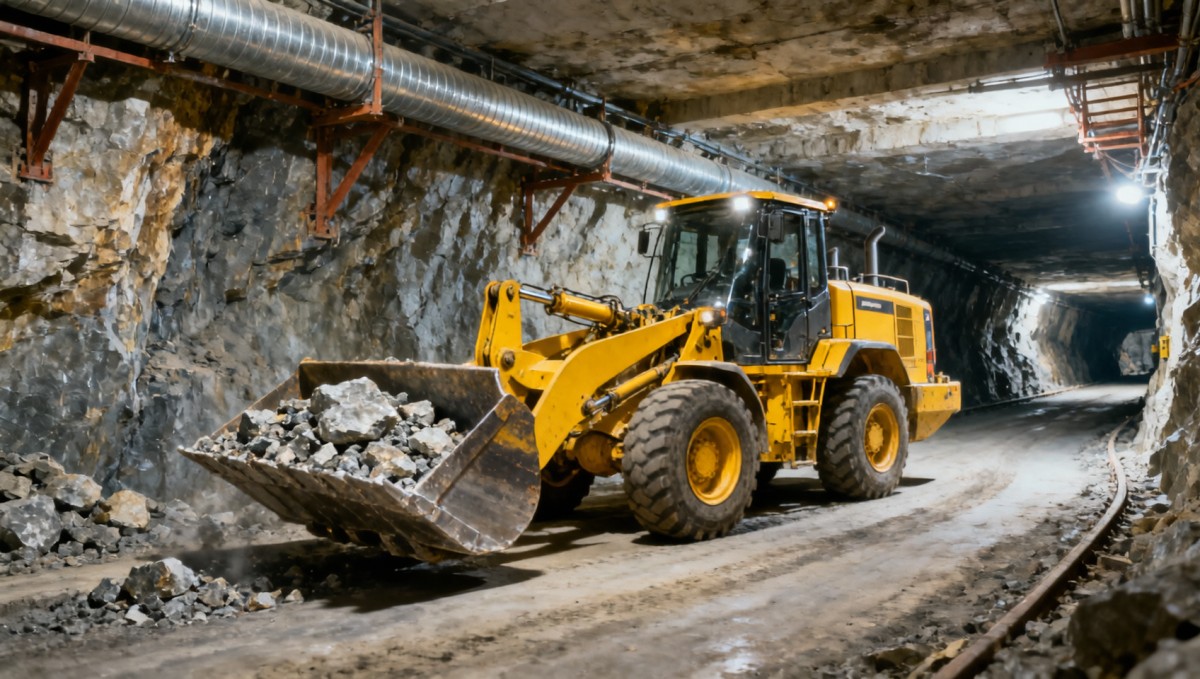
Map the proposed machine through critical intersections, drawpoint approaches, passing areas, and dump stations using its configuration-specific geometry. Include bucket corners, rear swing, articulation limits, and the effect of approaching a turn at an angle. Where movement is especially constrained, a physical trial or validated route simulation offers stronger evidence than a dimensional comparison alone.
Vertical clearance must cover operating positions, not just travel height. Check canopy or cab clearance, pitch changes at ramp transitions, bucket lift and dump trajectories, and maintenance access. An acceptable travel envelope can still fail at an ore pass if the bucket cannot discharge without contacting services or structures.
Allowances should reflect the mine’s ground-control and operating requirements rather than a generic clearance margin. A machine that fits only under ideal road and support conditions has little tolerance for rutting, spillage, or changed services. Restricted clearance can also reduce speed, visibility, and pedestrian separation, creating a production penalty even where physical passage remains possible.
Treat ventilation as an operating limit, not a paperwork check
For a diesel underground loader, ventilation suitability depends on the engine, its emissions-control system, operating load, other equipment in the district, and the mine’s ventilation network. Installed engine power alone does not establish the required airflow. Applicable rules may prescribe power-based quantities, approved-engine requirements, contaminant limits, or a combination of these.
Obtain the requirements for the specific jurisdiction and mine type, together with emissions and approval documentation for the exact engine configuration. A surface-equipment emissions designation does not, by itself, demonstrate suitability for underground operation. Coal and other potentially explosive environments can impose additional equipment restrictions that change which powertrains and configurations are permissible.
The ventilation assessment should distinguish between:
- Exhaust contaminants: including diesel particulate matter, nitrogen oxides, and carbon monoxide, with controls assessed against applicable exposure requirements.
- Heat rejection: engine cooling, exhaust, drivetrain losses, and the resulting burden on air movement or refrigeration.
- Air delivery: whether sufficient fresh air reaches the operating location under credible simultaneous fleet conditions.
Fan capacity at the surface is not equivalent to airflow at the loader. Leakage, recirculation, auxiliary duct resistance, and changes in working locations can restrict delivery. Assess the machine within the ventilation circuit in which it will operate, including periods when other diesel equipment is active nearby.
Diesel aftertreatment also needs a duty-cycle check. Particulate filters and other systems have temperature, maintenance, and operating requirements. Extended low-load operation may affect regeneration strategy; permitted regeneration arrangements must be compatible with underground fire controls. Request the supplier’s operating restrictions and service requirements rather than assuming a cleaner engine eliminates ventilation constraints.
Battery-electric changes the constraint, but does not remove it
A battery-electric loader eliminates diesel exhaust at the machine and can reduce heat released underground for comparable work. It does not make ventilation unnecessary. Rock heat, dust, blasting fumes, people, other equipment, and electrical losses remain part of the ventilation and cooling balance.
The key selection question is whether the battery and charging system can sustain the required route without unacceptable production interruptions. Compare usable energy within the permitted state-of-charge window, not nominal battery capacity. Account for auxiliary loads, thermal-management demand, battery aging, and the reserve needed to reach a safe charging or exchange location.
Route direction matters. Carrying a loaded bucket uphill demands a different energy budget from carrying it downhill. Regenerative braking can recover energy, but recovery is limited by battery state of charge, temperature, traction, and system capability. A fully charged battery at the start of a loaded descent may have limited capacity to accept regenerated energy, so independent braking performance remains essential.
Charging and battery swapping create different infrastructure dependencies. Opportunity charging requires enough power and dwell time at suitable locations. Battery swapping can shorten the machine’s replenishment stop but requires spare packs, handling equipment, protected work areas, and disciplined procedures. Neither should be assessed using the replenishment time alone: queues, travel to the station, connection work, and equipment availability belong in the production model.
Verify electrical distribution capacity, charger compatibility, cooling requirements, and arrangements for isolating damaged equipment. Battery chemistry and pack construction influence fire response, fault detection, and recovery procedures. These provisions must fit the mine’s emergency plan and applicable approval requirements.
Compare complete configurations on the same operating basis
Diesel and battery-electric proposals should use the same payload assumptions, route, production window, and environmental conditions. Otherwise, a comparison may favor a machine simply because its estimate excludes delays or uses a more favorable duty cycle.
Assess lifecycle cost against achievable production, preferably as cost per delivered tonne. Include the machine, infrastructure changes, maintenance, tires, energy, ventilation or cooling impacts, and replenishment downtime. Battery replacement assumptions should state the expected duty and capacity-retention basis. Diesel estimates should include aftertreatment service obligations. Do not credit ventilation savings unless the mine’s network assessment supports them.
Make acceptance criteria reflect the mine’s bottlenecks
A purchase specification should convert the assessment into measurable acceptance conditions. Define the bucket and tire configuration, payload range, route, gradients, ambient conditions, and production window. Require documentation for braking, protective structures, fire controls, electrical systems, and relevant underground approvals, using the standards and rules applicable to the installation.
Performance verification should measure delivered tonnes, cycle-time components, energy or fuel consumption, replenishment interruptions, and thermal behavior over a representative duty period. A brief demonstration with favorable material or a partially loaded bucket cannot establish sustained production capability. Record the conditions carefully so that results can be compared with the supplier’s assumptions.
The final decision should turn on the binding constraint. If clearance limits maneuvering, additional payload may add little output. If ventilation restricts diesel operating hours, an electric configuration may justify its infrastructure burden. If charging access limits productive time, a smaller energy-efficient machine or a different replenishment arrangement may outperform a larger alternative. Select the configuration with a demonstrated operating margin at the constraint that actually governs the mine—not the one with the strongest isolated specification.
Recommended News
 Oct 14, 2026Choosing an Underground Loader: Payload, Clearance, and Ventilation NeedsChoose the right underground loader by comparing payload, clearance, and ventilation needs. Discover how to boost mine productivity and avoid costly sizing mistakes.
 Sep 07, 2026How automation is changing job roles in underground miningExplore the impact of automation on mine jobs, from remote operations and predictive maintenance to new skills, safer workflows, and workforce planning.
 Sep 02, 2026How to use bucket fill factor calculation to estimate loader productivityBucket fill factor calculation made practical: learn to estimate loader productivity with real payload, loose density, cycle time, and efficiency data.
 Sep 04, 2026What Causes the Most Downtime in Underground Mining Operations?What causes the most downtime in underground mining operations? Explore key risks—from equipment and power failures to ventilation, ground control, and spare parts—and practical ways to protect output.