How does air holdup affect recovery in column flotation?
Column flotation air holdup affects recovery by changing the amount of bubble surface available to collect mineral particles and the conditions under which those particles travel to the concentrate. Increasing holdup can improve collection when a column is short of effective bubble surface. Beyond a suitable operating range, however, more gas may reduce selectivity, destabilize the froth or produce little additional recovery.
The right target depends on the ore, bubble size, sparger performance, wash water and the column’s operating conditions. A holdup reading is most useful when interpreted alongside concentrate grade, recovery and froth behavior rather than treated as a performance target on its own.
What air holdup tells you about a flotation column
Air holdup, often called gas holdup, is the fraction of a specified volume of the column occupied by gas bubbles. It can be expressed as a fraction or percentage. In practice, a measurement may represent a section of the collection zone, an average over a larger region, or a reading influenced by the interface between pulp and froth. Those distinctions matter when comparing results.
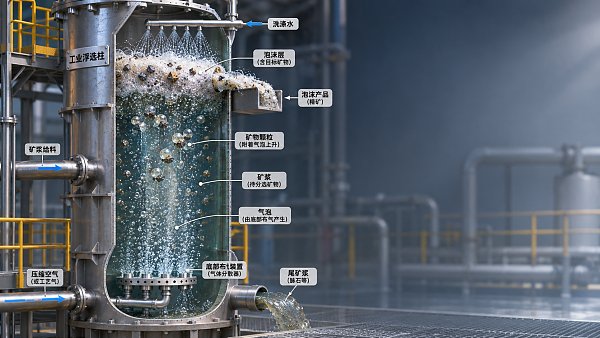
Air enters the column through a sparging system and rises through the downward-moving slurry. Hydrophobic mineral particles can collide with bubbles, attach to them and move upward into the froth. Wash water applied near the top of the column helps reduce the amount of unwanted material carried into the concentrate.
Holdup describes how much gas is present at a given time. It does not directly identify how many bubbles are present, how large they are, or whether they are distributed evenly across the column. Two columns can therefore report similar holdup while providing different conditions for mineral collection.
Why increasing holdup can improve recovery
When effective bubble surface is scarce, some floatable particles pass through the collection zone without encountering a suitable bubble. Raising the gas input, improving dispersion, or both can increase the opportunity for bubble–particle contact. Recovery may rise, particularly where fine, slow-floating particles need more contact opportunities.
Bubble size is central to this effect. For a given volume of gas, smaller bubbles provide more total surface area than larger bubbles. This gives particles more potential attachment sites, although attachment still depends on particle size, mineral surface chemistry and local hydrodynamics.
Evaluators often use bubble surface area flux to relate the rate at which bubble surface passes through the column to its cross-sectional area. It combines information about gas flow and bubble size, making it a useful complement to holdup. Neither measure alone establishes how much mineral will attach or survive transport into the concentrate.
Recovery can also be affected by how long bubbles and particles remain in contact within the collection zone. Holdup reflects gas flow and bubble residence behavior together: a change in the reading may result from a different gas input, a change in bubble rise behavior, or both. This is one reason a holdup increase should not automatically be interpreted as improved collection.
When more air stops helping
As gas input rises, bubbles can interact and coalesce. Larger bubbles have less surface area per unit volume of gas, so the increase in useful collecting surface may be smaller than the increase in gas volume suggests. Changes in flow patterns can also produce uneven dispersion, with some regions receiving more gas than others.
Higher gas rates may disturb the pulp–froth interface or make froth handling more difficult. Depending on the column and feed, stronger local agitation can also reduce the stability of some particle–bubble attachments. The result may be a recovery plateau or a decline even while measured holdup continues to rise.
Concentrate grade can deteriorate for a different reason: more water and fine gangue may be carried into the froth by entrainment, without attaching to bubbles. A recovery increase accompanied by lower grade is not necessarily evidence of better selective flotation. It may partly reflect unwanted material reporting to the concentrate.
The operating objective is therefore not maximum holdup. It is an acceptable combination of valuable-mineral recovery, concentrate quality and stable operation, subject to the duty of the column and the downstream flowsheet.
Froth recovery can change the result
Collection in the pulp is only part of the process. Once a mineral-bearing bubble reaches the froth, the particle must remain attached and reach the concentrate launder. Drainage, bubble coalescence, froth depth and wash water all influence that journey.
A gas adjustment can improve collection-zone recovery while worsening froth recovery. For example, a more heavily loaded or less stable froth may return some collected particles to the pulp. The final concentrate response will then be smaller than the improvement in bubble–particle contact might suggest.
Wash water introduces another trade-off. Effective washing can reduce entrainment and improve concentrate grade, but its effect depends on distribution, flow and froth conditions. Excessive or poorly distributed wash water can disturb the froth or increase the return of valuable particles to the pulp. Gas rate and wash water should therefore be assessed together when the purpose is to improve overall separation.
How to interpret a holdup measurement
Before using a reading to compare operating periods or equipment, establish where and how it was measured. The collection zone and froth have different structures and gas fractions; a reading that includes both should not be compared directly with a collection-zone measurement.
Common approaches include pressure-based measurements over a defined section and electrical or other local probes. Each has a different measurement volume and response. A pressure-based calculation, for example, depends on assumptions or measurements of the density of the non-gas phase and can be affected by solids concentration. Local probes can reveal changes at a point but may not represent the entire cross-section.
A useful comparison record includes:
- Measurement location and method: the section or point represented, instrument arrangement and calculation basis.
- Gas and slurry conditions: gas flow, slurry flow, solids concentration and operating pressure where relevant.
- Separation conditions: feed grade, particle-size distribution, reagent regime, froth depth and wash-water settings.
- Performance: valuable-mineral recovery, concentrate grade, mass pull and operating stability over the same representative period.
Sampling time matters as well. A brief holdup reading taken during a feed disturbance may not correspond to a composite sample collected over a longer period. Aligning measurements and allowing the column to settle after a change makes the relationship between gas conditions and metallurgical performance easier to interpret.
Which operating variables change the relationship?
Gas rate and sparger condition
Gas rate affects holdup, but the response depends on how the sparger disperses the gas. Sparger design, wear, partial blockage and changing pressure conditions can alter bubble size or distribution. If recovery falls while the indicated gas flow remains steady, a change in dispersion is one possible explanation. Check sparger condition and gas distribution before assuming that more air is needed.
Feed properties and reagents
Particle size and mineral surface properties determine how readily material collides with and attaches to bubbles. Coarser particles can be harder to keep attached under unfavorable conditions; very fine particles may require more contact opportunities and can also be susceptible to entrainment. A change in the feed-size distribution can therefore alter the best gas setting.
Frother affects bubble formation and stability, while collectors and other reagents influence mineral hydrophobicity and selectivity. Changes in water chemistry or recycled process water can also change flotation behavior. If these conditions move at the same time as gas rate, attributing a recovery change solely to holdup is unreliable.
Froth depth and wash water
Froth depth and wash-water addition influence drainage, entrainment and the return of particles to the pulp. A deeper or better-washed froth may improve grade, but the effect on recovery depends on whether valuable particles remain attached long enough to reach the launder. The same holdup can therefore produce different concentrate results under different froth settings.
How to evaluate an operating change
Start with a stable baseline and a clear metallurgical objective. If valuable mineral is being lost to tailings and concentrate quality has room to absorb a change, a controlled increase in gas input may be worth examining. If grade is already constrained by gangue carryover or the froth is unstable, investigate those limitations before treating higher gas input as the primary solution.
Change one principal variable at a time where operating conditions permit. At each setting, allow the column and sampling system to approach a representative condition, then measure both metallurgical performance and the gas environment. Record gas flow and holdup together; add bubble-size or surface-area information when suitable measurement is available.
Interpret the response as a set of outcomes rather than a single number:
- Recovery rises and grade remains acceptable: the previous condition may have limited collection. Check that the improvement is repeatable and stable.
- Recovery rises but grade falls: examine mass pull, water recovery, entrainment and froth washing before deciding whether the change is beneficial.
- Holdup rises but recovery does not: collection may no longer be limited by gas availability, or changes in bubble size, dispersion or froth recovery may offset the benefit.
- Both recovery and grade deteriorate: inspect froth stability, sparger behavior and concurrent feed or reagent changes before selecting a corrective action.
These patterns help direct the next investigation; none identifies a single cause by itself. Material balances and representative samples are especially important when observed changes are small relative to normal process variation.
Comparing columns and assessing scale-up
A holdup value from one column should not be transferred directly as the target for another. Columns with different heights, diameters, spargers and internal flow patterns may reach the same average gas fraction with different bubble sizes and gas distributions. Feed and froth duties can differ as well.
For scale-up or equipment evaluation, ask how the proposed sparging system will distribute gas across the vessel and how its condition can be monitored during operation. Compare the intended ranges of gas and slurry flow, collection-zone depth, wash-water distribution and froth handling. Bench or pilot results are more useful when the measurement method, feed characteristics and operating conditions are documented alongside recovery and grade.
Rather than specifying a single preferred holdup value in isolation, define an operating window supported by the relevant test work and metallurgical targets. Include the measurements needed to detect when a change in feed, sparger performance or froth behavior has shifted that window. The strongest assessment links gas conditions to a repeatable separation result and shows what operators can adjust when the process moves away from it.
Recommended News
 Nov 13, 2026Can digitalization improve mineral recovery in flotation?Explore how digitalization and flotation performance connect, and learn how sensors, process control, and reliable trials can support mineral recovery.
 Nov 08, 2026How does air holdup affect recovery in column flotation?Column flotation air holdup can improve recovery, but more air isn't always better. Explore the trade-offs and find ways to optimize performance.
 Sep 23, 2026What drives reagent consumption per ton price trends in flotation?Reagent consumption per ton price trend explained: uncover how ore variability, dosage, logistics, and plant performance shape flotation costs and smarter purchasing decisions.
 Aug 17, 2026Do surfactants improve flotation recovery in fine ores?Surfactants can improve fine-ore flotation recovery when matched to ore type, water chemistry, and reagents. Learn when they boost recovery without sacrificing grade or control.