Do surfactants improve flotation recovery in fine ores?
In fine ore flotation, surfactants can improve recovery, but only when they are chosen and controlled for the specific ore, water chemistry, and reagent scheme. For technical evaluators, the real question is not whether surfactants work in theory, but whether they raise recovery without hurting selectivity, froth handling, or downstream costs.
What Technical Evaluators Need to Know
Surfactants can help disperse ultrafine particles, stabilize bubbles, and modify mineral surfaces, which often improves fine-ore flotation kinetics. Yet the same chemistry can also create excess froth, depress valuable minerals, or increase reagent consumption if the system is poorly matched.
For this reason, the best assessment is conditional: surfactants are useful when they address a specific flotation limitation, such as slime coating, poor dispersion, or unstable bubble attachment. They are not a universal recovery booster, and their value must be tested against ore mineralogy and circuit constraints.
Why Fine Ores Are Hard to Float
Fine ores are difficult because particle size reduces collision probability, increases entrainment risk, and makes mineral surfaces more sensitive to slimes and dissolved ions. Recovery losses often come from weak attachment rather than insufficient collector chemistry alone.
As particle size drops, hydrodynamic behavior becomes more important. A reagent that works well on coarser feed may perform poorly on fines if it produces unstable froth or pushes gangue into the concentrate through entrainment.
That is why evaluation should start with the ore itself. Mineral liberation, particle size distribution, clay content, and water quality all shape whether surfactants help or hinder the flotation response.
How Surfactants Influence Recovery
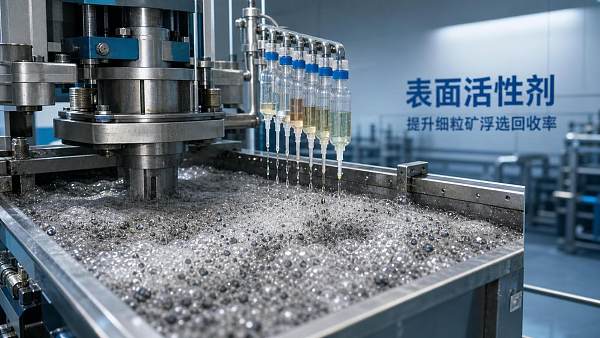
Surfactants affect flotation through several mechanisms, including bubble stabilization, surface tension reduction, particle dispersion, and changes in collector adsorption. In fine ores, these effects can improve the probability of particle-bubble attachment.
Some surfactants also reduce agglomeration among ultrafines, which helps keep valuable particles available for capture. In ores with strong slime interference, this can produce measurable gains in both grade and recovery.
But surfactants can also be too effective. If they create overly persistent froth or excessive surface activity, they may increase water recovery and entrain non-value minerals, especially in circuits already sensitive to froth crowding.
Where They Deliver the Most Value
Surfactants tend to be most valuable in sulfide and oxide systems where fine particles suffer from poor dispersion or unstable bubble contact. They are also useful when ore contains clays, talc, or other fine gangue that interferes with selective recovery.
In low-grade fine feed, even a modest increase in recovery can justify reagent cost if concentrate quality remains stable. This is especially true when throughput is constrained and small metallurgical gains translate into meaningful production value.
They are less attractive when the circuit already has strong froth control and high collector efficiency. In those cases, the incremental benefit may not offset the risks of higher entrainment or more difficult dewatering.
What to Evaluate Before Plant Trials
Before adopting surfactants, technical evaluators should test compatibility with the full reagent suite, including collectors, frothers, depressants, and water treatment chemicals. Interactions often determine whether the surfactant improves selectivity or merely increases froth activity.
Bench and pilot testing should track recovery, concentrate grade, froth stability, reagent dosage, and mass pull, not recovery alone. A reagent that lifts recovery by a few points but damages grade or thickener performance may reduce overall plant value.
Water chemistry is equally important. Hardness, salinity, and dissolved metals can change surfactant performance significantly, so tests should reflect actual plant water rather than ideal lab conditions.
Practical Judgement on Cost and Risk
The economic case for surfactants depends on whether the added recovery is durable and repeatable across ore variability. A reagent that works only on one ore type or one moisture window is not a robust operating solution.
Hidden costs matter as much as metallurgical gains. Excess froth, poorer filtration, higher frother demand, and more complex process control can erode the benefit of improved flotation recovery in fine ores.
For procurement and technical teams, the best decision rule is simple: accept surfactants when they solve a defined recovery bottleneck and preserve downstream performance. Reject them when they rely on broad claims but lack ore-specific evidence.
Conclusion
So, do surfactants improve flotation recovery in fine ores? Yes, often they do, but only under the right mineralogical and operational conditions. Their value comes from improving dispersion, bubble interaction, and surface behavior in systems where fine particles are otherwise difficult to recover.
For technical evaluators, the correct approach is controlled testing, not assumption. The strongest candidates are surfactants that improve recovery while holding grade, froth behavior, and operating cost within acceptable limits.
In practice, surfactants are best treated as targeted performance tools. When matched to the ore and validated in plant-like conditions, they can be a useful lever for fine-ore flotation recovery.
Recommended News
 Sep 23, 2026What drives reagent consumption per ton price trends in flotation?Reagent consumption per ton price trend explained: uncover how ore variability, dosage, logistics, and plant performance shape flotation costs and smarter purchasing decisions.
 Aug 17, 2026Do surfactants improve flotation recovery in fine ores?Surfactants can improve fine-ore flotation recovery when matched to ore type, water chemistry, and reagents. Learn when they boost recovery without sacrificing grade or control.
 Aug 04, 2026Flotation Machine Wholesale: How to Compare Cell Size, Recovery Rate, and Total CostFlotation machine wholesale buying guide: compare cell size, recovery claims, energy use, wear parts, and total cost to choose the right package and avoid expensive procurement mistakes.
 Jun 16, 2026Flotation Machines: Key Performance Factors for Better Recovery RatesFlotationmachines performance depends on air dispersion, froth control, reagent response, and stability. Learn how to compare designs and improve recovery rates with practical insights.