Can digitalization improve mineral recovery in flotation?
Digitalization can improve mineral recovery in flotation when it helps a plant detect process changes and respond before valuable minerals are lost to tailings. The result depends on more than installing sensors or applying artificial intelligence: the plant needs reliable measurements, usable control equipment, and an operating strategy that balances recovery with concentrate quality and cost.
When assessing digitalization and flotation performance, the practical question is where an intervention can change the outcome. A camera may reveal unstable froth, for example, but recovery will improve only if operators or a control system can use that information to make an effective adjustment. A well-instrumented circuit can still perform poorly if feed conditions exceed its physical capacity or if sampling does not support sound decisions.
Where digital tools can influence recovery
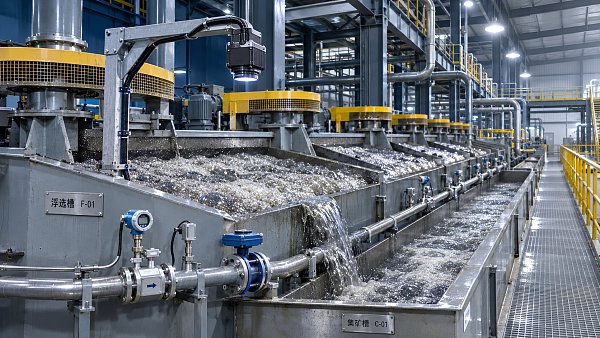
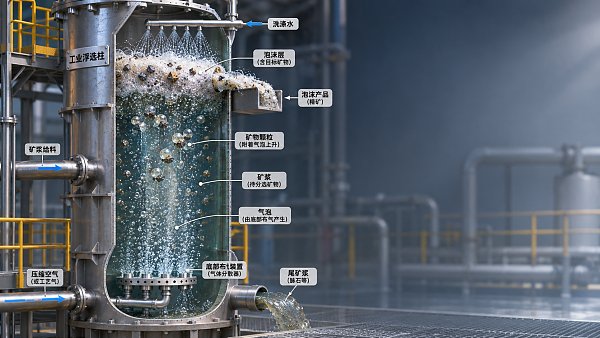
Flotation separates minerals by exploiting differences in how their surfaces interact with reagents and air bubbles. Valuable particles attach to bubbles and rise into a froth that is removed as concentrate. The separation is sensitive to feed mineralogy, particle size, pulp chemistry, air flow, froth depth, residence time, and interactions between cells.
These variables do not stay constant. A change in ore hardness can alter grinding performance and particle size; a change in mineralogy can affect reagent demand; variations in water quality can change flotation chemistry. Digital systems help by measuring some of these changes more frequently, combining signals that operators might otherwise view separately, and adjusting controllable variables within defined limits.
Consider a circuit where froth becomes unstable after a change in feed. A vision system may detect a change in froth appearance, while process data show an accompanying shift in air flow or pulp level. An operator or controller can then investigate and adjust the relevant setpoints. Whether that response improves recovery depends on the cause of the instability and on how well the measured froth characteristics relate to mineral transport in that circuit.
Digitalization has less room to help when the main constraint is physical. Insufficient grinding capacity, blocked launders, worn components, inadequate air delivery, or poorly maintained valves can limit the value of a control project. Better information may expose such constraints, but software cannot remove them on its own.
What the main technologies actually contribute
Online measurement and data integration
Instrumentation provides the foundation for digital flotation control. Depending on the circuit, useful inputs may include feed rate, density, particle size, pH, pulp level, air flow, reagent flow, and online elemental assays. Connecting these measurements with laboratory results and equipment status gives operators a more complete view of the process.
Measurement frequency alone is not enough. An online analyzer may report frequently but still have a meaningful delay between sampling and result. A pH probe may be responsive but drift if it is not maintained. Reagent pump signals may show a requested dose rather than the quantity actually delivered. These distinctions matter when a model or controller uses the data to recommend an action.
Evaluators should follow each important signal back to its source: where the sample or sensor sits, which stream it represents, how it is calibrated, and how missing or suspect readings are handled. Data from a poorly located sensor can make an otherwise sophisticated system respond to the wrong part of the circuit.
Froth cameras and machine vision
Froth cameras can track visual features such as bubble size, froth velocity, texture, and stability. These measurements are useful because froth behavior affects how mineral-bearing material moves into the concentrate. A consistent camera view can also reveal changes that are difficult to compare across shifts using observation alone.
Visual features are indirect indicators, however. A change in froth appearance does not automatically identify its cause or establish whether recovery has improved. Lighting, camera cleanliness, obstruction, and changes in water addition can affect the image. A useful evaluation checks whether the features remain meaningful across different ores and operating conditions, and whether they can be linked to actions such as adjusting air or froth depth.
Advanced process control
Advanced process control uses measurements and a process model or control logic to coordinate adjustments. For example, it may manage pulp levels and air rates across several cells while respecting equipment and operating limits. This can reduce the variability created when individual setpoints are adjusted independently.
The control hierarchy matters. Before adding a supervisory controller, the underlying control loops should be sufficiently stable: a higher-level system cannot reliably control froth depth if a level sensor is faulty or a valve does not respond as expected. Operators also need clear limits, a way to take control, and a defined response when inputs become unavailable.
Recovery improvement is not guaranteed merely because control becomes steadier. The chosen objective may favor concentrate grade, throughput, reagent consumption, or some combination of these. The operating objective and its constraints should be agreed before performance is assessed.
Predictive models and digital twins
A predictive model can estimate an outcome that is slow or difficult to measure directly, such as a tailings grade or a recovery trend. It may use process measurements, laboratory results, and historical operating data to produce an estimate or recommend a setpoint. A digital twin can combine process relationships and live data to support monitoring or scenario analysis.
Both approaches depend on the conditions represented in their models. A model trained on one range of ore types may be less reliable after a feed change. Similarly, an apparent relationship between reagent addition and recovery may reflect an operator’s response to difficult ore rather than the effect of the reagent itself. The evaluation should therefore cover performance during feed transitions, unusual operating periods, and missing-data events—not just during stable production.
How to tell whether recovery has improved
Recovery is the proportion of the valuable metal or mineral entering the circuit that reports to the concentrate. For metal recovery, a common calculation is:
Recovery = metal in concentrate ÷ metal in feed.
Those quantities depend on stream mass flow and assay. In practice, sampling, flow measurement, moisture determination, and assay quality all affect the result. Plants may use a metallurgical balance to reconcile measurements across streams; the method and circuit boundary should remain consistent when comparing periods. A recovery estimate inferred from grades alone relies on assumptions about the streams and should not be treated as independent proof if those assumptions are unreliable.
Recovery must also be read alongside concentrate grade. A change that pulls more material into concentrate can increase recovery while diluting the product or increasing downstream treatment costs. Conversely, a higher concentrate grade may come at the expense of valuable metal sent to tailings. The preferred balance depends on concentrate specifications, downstream capacity, metal value, and operating costs.
For a digital flotation trial, define the primary outcome and the limits around it before commissioning. A useful assessment normally includes:
- Metallurgical performance: recovery, concentrate grade, and tailings grade for the relevant metals or minerals.
- Operating context: feed rate, feed grade, ore type, particle size, and other variables that can explain changes in performance.
- Cost and constraints: reagent consumption, energy use where relevant, concentrate handling, and any limits on throughput or product quality.
- System availability: sensor quality, controller uptime, operator overrides, and periods when the system was outside its intended operating range.
A before-and-after comparison can be misleading if the plant processes different ore, changes grinding settings, or completes maintenance between the two periods. Where operationally practical, alternating the digital system on and off under a defined trial plan can provide a stronger comparison. The plan should account for process residence time and measurement delays, and compare similar operating conditions. If controlled switching is impractical, document other changes and use the available data to assess how much they could explain the result.
Short trials can reveal whether a system functions, but they may not cover the feed variability needed to judge its lasting effect. The amount of data required depends on how often relevant ore types and operating conditions occur, as well as the precision of the measurements. An improvement that is smaller than the uncertainty in the metallurgical balance should not be presented as a demonstrated gain.
Choosing a solution for the actual constraint
The most useful starting point is a specific loss mechanism or operating problem. If operators cannot see rapid froth changes, machine vision may be a practical addition. If measurements are available but cell levels and air rates interact in ways that are difficult to manage manually, advanced control may be more valuable. If laboratory results arrive too slowly for the decisions being made, a validated online measurement or predictive estimate may help.
These choices are complementary, but they do not all need to be deployed at once. A plant with unreliable instrumentation may gain more from repairing sensors, improving sampling, and tuning basic loops than from introducing a complex optimization model. A circuit already running consistently may need a carefully targeted application and a sensitive measurement plan to show whether further improvement is achievable.
Integration deserves the same attention as algorithm capability. Check how the proposed system connects to the existing control and historian infrastructure, whether it reads actual equipment feedback, and who maintains interfaces after control-system changes. If a vendor provides a model, establish how its performance will be monitored, when it will be updated, and what plant personnel can inspect or change.
For closed-loop control, review the consequences of bad inputs and lost communications. The system should have defined operating boundaries and a predictable way to return control to the existing strategy. Operator displays should explain what the system is doing clearly enough for staff to recognize an unsuitable recommendation or override an adjustment.
When a pilot is ready to scale
A successful pilot should demonstrate more than a favorable dashboard. It should show that the required measurements remain dependable, the control actions are accepted by operators, and the improvement survives normal changes in feed and operating conditions. It should also identify the maintenance work needed to keep cameras, analyzers, instruments, and models usable.
Before extending a solution to another bank or another plant, compare the process conditions that made the pilot effective. Cell design, ore mineralogy, reagent strategy, sensor placement, and control infrastructure can all change the relationship between a digital signal and a useful action. A model or setpoint strategy may need to be adapted even when the equipment appears similar.
The strongest basis for a decision is a traceable link from measurement to action to metallurgical result. If that link is clear, and the benefit remains credible after accounting for grade, cost, operating conditions, and measurement uncertainty, digitalization has a practical case for wider use.
Recommended News
 Nov 13, 2026Can digitalization improve mineral recovery in flotation?Explore how digitalization and flotation performance connect, and learn how sensors, process control, and reliable trials can support mineral recovery.
 Nov 08, 2026How does air holdup affect recovery in column flotation?Column flotation air holdup can improve recovery, but more air isn't always better. Explore the trade-offs and find ways to optimize performance.
 Sep 23, 2026What drives reagent consumption per ton price trends in flotation?Reagent consumption per ton price trend explained: uncover how ore variability, dosage, logistics, and plant performance shape flotation costs and smarter purchasing decisions.
 Aug 17, 2026Do surfactants improve flotation recovery in fine ores?Surfactants can improve fine-ore flotation recovery when matched to ore type, water chemistry, and reagents. Learn when they boost recovery without sacrificing grade or control.