What Compliance Documents Should a Mining Equipment Supplier Provide?
What Compliance Documents Should a Mining Equipment Supplier Provide?
What documents should a mining equipment supplier provide for compliance proof? For procurement teams, EPC contractors, and mine operators, the answer goes far beyond a polished brochure or a statement that equipment is “built to international standards.” A credible supplier should be able to provide a traceable evidence package covering product identity, engineering design, safety testing, manufacturing quality, legal market access, and—increasingly—environmental and supply-chain obligations.
This matters because mining equipment is rarely purchased in a regulatory vacuum. A feeder breaker for an underground coal operation, a mobile crusher for a quarry, an autonomous haulage component, and a flotation circuit serving a copper concentrator may each face different approval paths. The applicable requirements depend on the machine’s function, installation location, power source, hazardous-area classification, operator jurisdiction, mine-site rules, and contractual specifications. Compliance is therefore not a single certificate. It is a documented chain of proof.
The practical question is not simply whether documents exist. It is whether they match the exact equipment configuration being offered, remain valid, come from appropriate issuing bodies or test facilities, and can be verified before shipment or site acceptance.
Start With a Document Register, Not a Folder of PDFs
A serious supplier should issue a controlled compliance document register early in the bid or technical clarification stage. This register should list every document, its revision number, issue date, responsible party, equipment model or serial-number range, and status. It turns a collection of attachments into something procurement, engineering, HSE, and legal teams can review together.
The register should distinguish between documents that apply to the complete machine and those that apply only to purchased components. For example, a certified electrical enclosure does not automatically prove that the complete skid-mounted package is compliant. Likewise, a diesel engine emissions statement may be relevant, but it does not replace machinery safety evidence for the integrated loader, crusher, drill rig, or conveyor system.
This distinction is often where project risk begins. Suppliers may provide abundant paperwork while leaving unclear what has actually been assessed at system level. For large process plants and material-handling systems, interfaces between motors, drives, guards, hydraulic units, control logic, emergency stops, and site infrastructure deserve as much attention as the individual equipment certificates.
Core Documents for Product Identity and Legal Market Access
At a minimum, buyers should expect documents that establish exactly what is being supplied. A commercial quotation is not sufficient. The technical documentation should identify the manufacturer, model, configuration, major assemblies, rated capacity, applicable duty cycle, power source, and intended operating conditions. For serialised equipment, final records should connect the delivered unit to its serial number and build documentation.
Depending on the destination market and equipment category, the supplier may also need to provide a declaration of conformity or equivalent market-access declaration. In some jurisdictions, this is central to placing machinery on the market; elsewhere, local registration, inspection, import documentation, or mine-specific approval may carry more weight. A declaration should name the applicable legal framework or standards and be signed by an authorised party. Generic declarations with no model reference, no revision control, or no connection to the delivered configuration should be treated cautiously.
Buyers should also request evidence of the manufacturer’s legal identity, manufacturing location, and authorised representative where required. This is not administrative trivia. If a defect investigation, product recall, warranty dispute, or regulatory inquiry arises years later, traceable legal accountability matters.
Engineering Evidence: Drawings, Calculations, and the Technical File
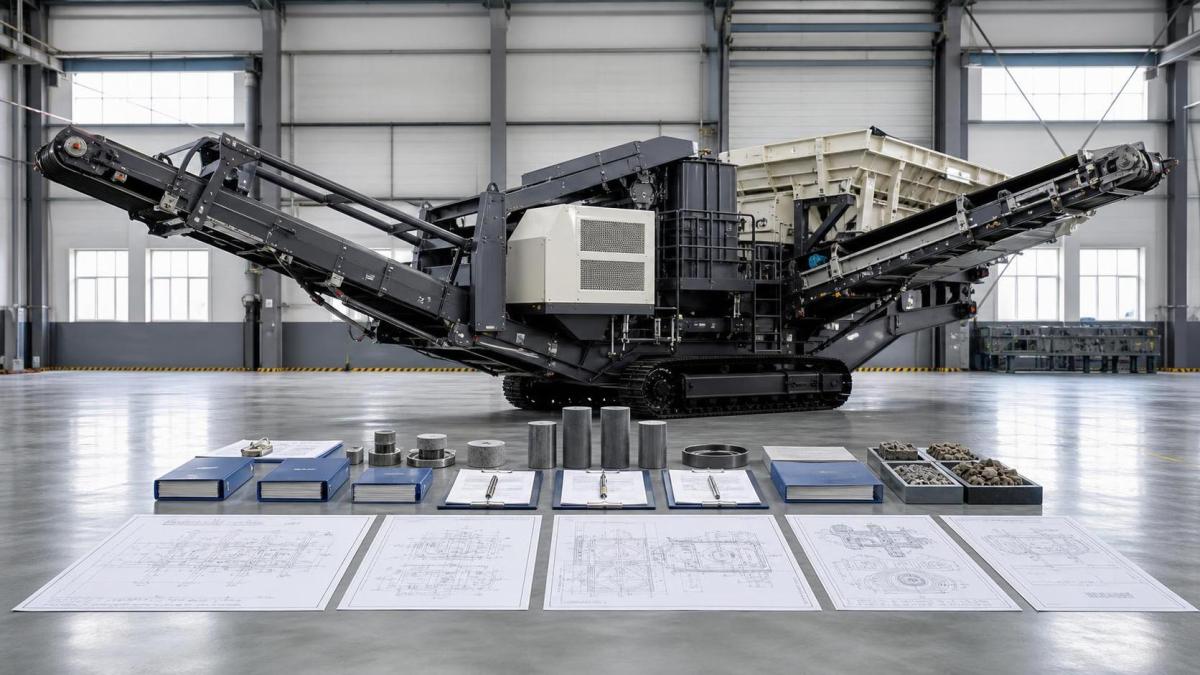
A mining machine may be physically impressive and still be poorly documented. The essential engineering package normally includes general arrangement drawings, foundation or installation requirements, electrical single-line diagrams, hydraulic and pneumatic schematics where relevant, control architecture, parts lists, and interface data. For processing and bulk-material-handling equipment, process data such as throughput assumptions, feed characteristics, motor loads, belt speeds, and design limitations should be explicit rather than implied.
Where structural integrity is material to safety, the buyer may require design calculations, finite-element analysis summaries, weld design information, lifting-point verification, fatigue considerations, or third-party design review. The required level of detail will vary. A site does not necessarily need the supplier’s entire proprietary design file, but it should receive enough substantiation to assess whether the machine suits its duty cycle, ambient conditions, altitude, corrosion environment, seismic requirements, and maintenance strategy.
The supplier should be able to explain the standards used in the design basis. ISO standards, AS/NZS standards, national mine safety rules, and customer engineering specifications may all be relevant, but citing a standard is not proof of conformity by itself. Ask which clauses were considered, which assumptions were used, and whether deviations were formally recorded and accepted.
Safety Documentation Must Address Real Operating Hazards
Mining equipment compliance is fundamentally about controlling hazards in difficult operating environments. The supplier’s safety file should normally include a documented risk assessment, a list of residual risks, and evidence showing how foreseeable hazards have been addressed through design, guarding, controls, warnings, and operating instructions.
For mobile and fixed equipment alike, review the safeguards that affect actual field work: emergency-stop architecture, interlocks, access platforms, guarding around rotating parts, pinch-point protection, braking systems, fire detection or suppression interfaces where specified, isolation points, lockout/tagout provisions, and safe maintenance access. For automated or remotely operated equipment, the documentation should also clarify communication failure modes, manual override conditions, geofencing or exclusion-zone logic where applicable, and the safe state of the machine after a control-system fault.
Test reports should be linked to the relevant product version. Factory acceptance test records can demonstrate that specified functions were checked before dispatch, while site acceptance testing verifies that equipment works safely in its installed environment. Neither document should be mistaken for the other. A conveyor can pass a workshop test yet require further validation after site integration with upstream equipment, downstream chutes, plant control systems, and emergency-stop circuits.
Explosion-Protected and Underground Equipment Needs Special Scrutiny
Equipment intended for potentially explosive atmospheres, especially in underground operations, requires a more exacting review. The relevant certification route depends on the local legal regime and hazardous-area classification. Buyers should request the applicable certificate, schedule or annexes identifying approved equipment variants, marking details, installation conditions, and instructions needed to preserve protection integrity.
It is important to check the certificate against the supplied equipment, not merely the supplier’s catalogue. Modifications to cable entries, enclosures, batteries, motors, sensors, software, hydraulic systems, or ancillary components can affect the approved configuration. If the project involves methane, coal dust, combustible dust, or other hazardous conditions, site compliance personnel should review the package before mobilisation rather than relying on commercial assurances.
Quality-Control Records Prove How the Machine Was Built
Certification can indicate that a management system or product assessment exists. It does not, on its own, prove that a particular machine was manufactured correctly. For high-value equipment, the supplier should provide an inspection and test plan, quality plan, inspection records, and non-conformance records where contractually required.
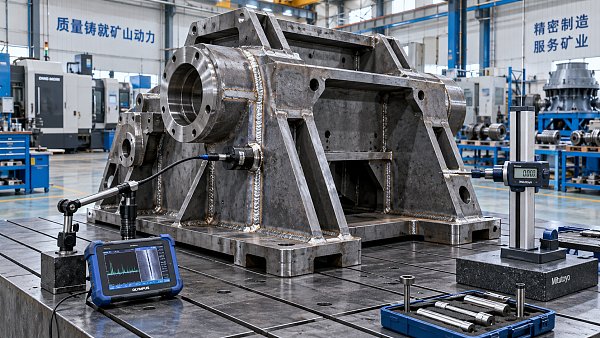
The depth of the manufacturing record should reflect the criticality of the equipment. Common items include material certificates for safety-critical components, welding procedure specifications, welder qualifications, non-destructive examination reports, dimensional inspection records, pressure-test certificates, calibration certificates for measuring equipment, paint or coating records, and final inspection release notes. These records are particularly relevant for pressure systems, structural assemblies, slurry-handling equipment, large fabricated chutes, lifting devices, and components exposed to abrasive or corrosive service.
A useful question is: can the supplier trace a safety-critical component from the final assembly back to its material and manufacturing records? If the answer is unclear, future root-cause analysis becomes harder and spare-parts substitution risk rises.
Environmental, ESG, and Responsible-Supply Documentation
Environmental documentation is becoming more relevant in equipment evaluation, particularly for fleets, processing plants, and projects tied to critical minerals or public infrastructure. The required evidence may include engine emissions information, fuel-consumption data under stated test conditions, noise data, refrigerant information, battery specifications, waste-handling instructions, or declarations concerning restricted substances. The exact form depends on the product and destination market.
For electric and hybrid equipment, buyers should look beyond a headline “zero-emission” claim. They may need battery transport documentation, charging-system requirements, thermal-management information, emergency response guidance, service procedures, and end-of-life responsibilities. A lower on-site emissions profile does not remove the need for robust electrical safety and lifecycle planning.
Broader ESG questionnaires may request supplier policies on labour practices, anti-bribery controls, conflict minerals, modern slavery, environmental management, and supply-chain due diligence. These are usually buyer- or lender-driven requirements rather than universal product certificates. A supplier should be transparent about what it can substantiate and avoid issuing unsupported declarations merely to satisfy a tender checklist.
Operations Manuals Are Part of Compliance, Not an Afterthought
The operating manual, maintenance manual, spare-parts catalogue, and training records are often treated as close-out documents. In reality, they are part of the compliance evidence because safe equipment can become unsafe when it is installed, operated, or maintained incorrectly. Manuals should be available in the language required by the project and should identify limitations, residual hazards, inspection intervals, lubrication requirements, consumables, torque settings where relevant, isolation procedures, and approved replacement parts.
Commissioning records are equally important. They should capture site conditions, completed checks, unresolved punch-list items, software versions, operator training, and acceptance criteria. If a machine has digital controls, remote diagnostics, or autonomous functions, clarify access rights, cybersecurity responsibilities, data ownership, and the process for software updates. A change in software can be a safety-relevant change, especially when it affects machine logic or protective functions.
How to Review a Supplier’s Compliance Package Without Losing Time
The most efficient reviews are risk-based. Rather than asking every bidder for every conceivable certificate, define the project’s non-negotiable compliance points before issuing the request for quotation. Identify jurisdiction, mine type, hazardous-area conditions, relevant client standards, power and emissions requirements, lifting or pressure-system obligations, documentation language, inspection hold points, and final handover format.
Then assess the supplier package against a few practical tests:
- Does each key document identify the offered model, configuration, or serial number?
- Are certificates current, issued by an appropriate body where third-party assessment is required, and independently verifiable?
- Do drawings, test reports, manuals, and declarations describe the same equipment version?
- Are exclusions, assumptions, and customer-supplied interface responsibilities plainly stated?
- Is there a controlled process for changes after approval, including substituted components and software revisions?
A low document count is not automatically a warning sign, and a large document archive is not automatically reassuring. The strongest package is coherent, relevant, traceable, and proportionate to the equipment’s operational risk.
Compliance Proof Should Support Lifecycle Decisions
For global mining projects, compliance review should connect with reliability, maintainability, and lifecycle cost—not sit in isolation with the legal team. Documentation revealing a supplier’s approach to fatigue life, component traceability, maintenance access, safety functions, emissions, and field modifications can also reveal how well that supplier understands mining duty.
This is the perspective used in technical benchmarking across open-pit and underground mining, mineral processing, heavy earthmoving, bulk material handling, and emerging green-mining systems. G-MRH’s work in these areas reflects a practical reality: equipment selection is more defensible when buyers can compare engineering evidence, jurisdictional requirements, and operational constraints on the same basis.
Before issuing a purchase order, ask the supplier for a final compliance matrix tied to the exact scope of supply and the project’s destination. It should show what has been submitted, what remains pending, who must approve it, and what changes would trigger re-review. That one disciplined step can prevent a certificate gap from becoming a commissioning delay, a rejected import, or a safety issue once equipment reaches the mine.
Recommended News
 Oct 22, 2026How import tariffs affect mining equipment procurement costsExplore mining industrial trade insights to see how import tariffs affect equipment costs. Compare landed costs, verify duty relief, and make smarter procurement decisions.
 Oct 19, 2026How to use trade insights to assess mining equipment import costsUse trade insights to assess mining equipment import costs, verify duties, compare freight routes, and uncover hidden charges. Build a reliable landed-cost estimate before you buy.
 Oct 24, 2026How Do Standardized Specs Affect Cross-Manufacturer Comparisons?How does equipment parameter standardization affect cross-manufacturer comparison? Discover how shared test methods clarify performance and help you make smarter equipment choices.
 Oct 23, 2026How Can You Verify a Mining Supplier Meets Global Quality Standards?How to verify if a mining equipment supplier meets international quality standards? Explore certificate checks, technical evidence, and factory audits to reduce risk and buy with confidence.