How Reliable Are Mining Equipment Manufacturers’ Performance Claims?
How reliable are performance claims from mining equipment manufacturers? Reliable enough to begin a technical evaluation, but rarely reliable enough to justify a purchase decision on their own. Published payload, availability, fuel burn, throughput, and emissions figures usually describe a defined test condition. A mine is not a test condition. Haul road grade, ore abrasiveness, operator practice, maintenance discipline, altitude, ambient temperature, and production targets can all move the result materially.
The practical question is not whether an OEM is being truthful. It is whether its claim applies to your duty cycle, site constraints, and operating model. The strongest buyers treat a brochure figure as a hypothesis to verify through operating data, contractual definitions, independent benchmarks, and evidence from comparable sites.
In short: performance claims are most dependable when the manufacturer states the test method, operating assumptions, equipment configuration, and measurement period. They become much less useful when a headline number is presented without context.
How Reliable Are Performance Claims From Mining Equipment Manufacturers?
They vary by claim type. Dimensional specifications, rated engine power, nominal bucket capacity, and certified safety features are normally easier to verify because they are linked to a defined machine configuration and, in many cases, controlled standards or approval processes. Claims about productivity, fuel efficiency, uptime, maintenance cost, and emissions performance require much more scrutiny. Those outcomes depend heavily on the mine environment and how the fleet is managed.
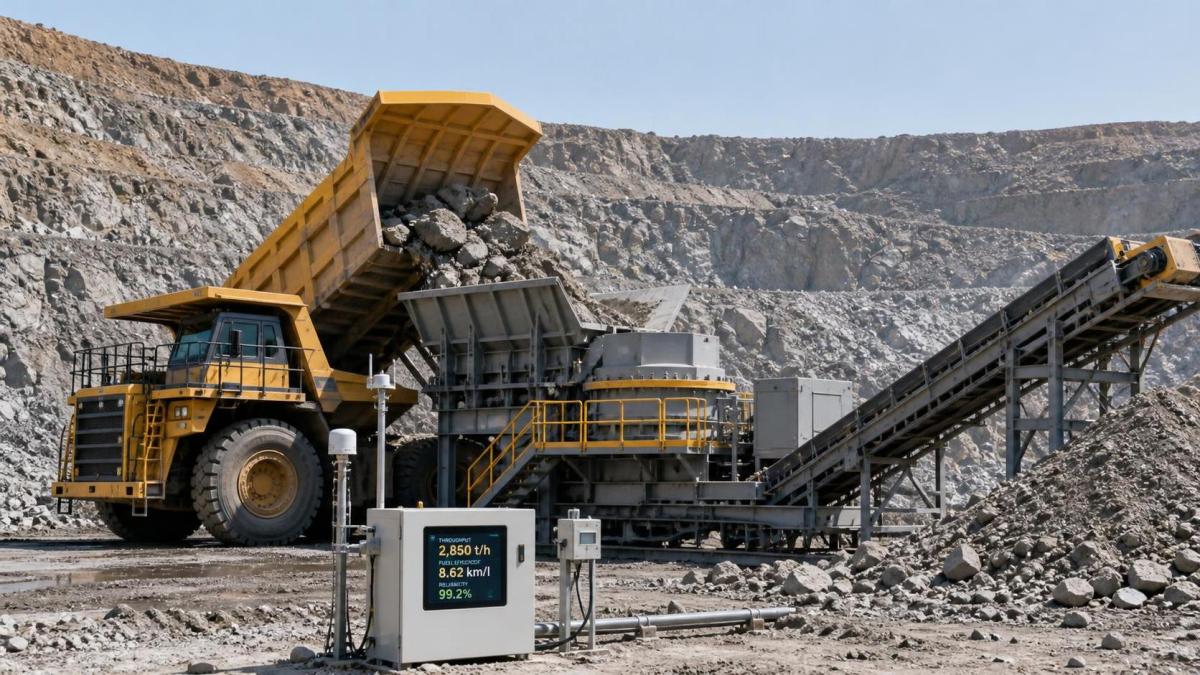
A crusher may meet a stated throughput rate on a specific feed size distribution, moisture range, liner condition, and closed-side setting. Change the feed from competent dry ore to wet, clay-rich material with variable oversize, and the installed machine can perform very differently. The brochure may still be technically correct. It may simply be irrelevant to the actual operating case.
The same applies to haul trucks. A claimed litres-per-hour or litres-per-tonne figure can be useful, but only after confirming payload policy, rolling resistance, haul profile, tyre selection, retarder use, idle time, road condition, and payload measurement method. Comparing one site’s litres per operating hour with another site’s litres per tonne moved can create a misleading conclusion before the comparison has even started.
Read the Conditions Behind the Number
Experienced equipment teams do not ask only, “What is the performance figure?” They ask, “Under what conditions was it achieved?” That one question exposes the quality of most claims.
Ask the manufacturer to document the basis for every material commercial promise. For a loading unit, this may include bucket fill factor, material density, cycle time, swing angle, loading height, and truck spotting time. For a processing plant, it may include feed PSD, ore competency, moisture, circulating load, availability exclusions, and product specification. For an underground machine, ventilation restrictions, gradient, tramming distance, battery temperature, and operator changeover time may matter as much as the machine’s nominal rating.
Pay particular attention to the words that are often left undefined:
- Availability: Is it mechanical availability, physical availability, scheduled availability, or another local definition? Are planned maintenance, waiting time, operator shortages, and site delays excluded?
- Productivity: Does the figure mean theoretical capacity, peak output, average output over a shift, or saleable product after quality losses?
- Fuel efficiency: Is consumption measured at the engine, from refuelling records, or from onboard telemetry? Is idle fuel included?
- Payload: Is it nominal payload, target payload, legal payload, or the payload that the machine can repeatedly carry without affecting component life?
- Low emissions: Does the claim refer to tailpipe emissions, energy use, lifecycle emissions, or a particular power source and duty cycle?
There is nothing unusual about a manufacturer presenting the best-supported result from its development programme. The buyer’s job is to establish the expected range at the intended site, not to assume the published figure is the guaranteed outcome.
Why Field Reliability Is Often More Valuable Than Peak Performance
Peak performance sells equipment. Repeatable performance keeps a mine operating.
A machine that delivers exceptional output for short periods but requires frequent unscheduled intervention may be less valuable than a slightly slower machine with predictable maintenance intervals, readily available parts, and a capable local service team. This is especially true where one critical asset constrains the entire production chain. A primary crusher, high-capacity conveyor drive, dragline, shaft hoist, or fleet dispatch system can create production losses that are disproportionate to its purchase price.
Field reliability should be assessed through a population, not a single reference. One successful installation may have unusually favourable geology, maintenance talent, spare-parts holdings, or OEM support. One troubled installation may be an early-production unit with unresolved commissioning issues. Seek several references that resemble the intended application, then ask consistent questions: How many hours have the units accumulated? Which components cause the most downtime? Are failures concentrated in the first year, after warranty, or near component overhaul intervals? How long does a typical repair actually take from fault detection to return to service?
Mean time between failures can help, but it should not be treated as a complete reliability verdict. It can hide a small number of severe failures, and manufacturers may define a “failure” differently. Review repair duration, recurring defect history, component replacement rates, and the operational impact of a failure. A ten-minute sensor fault and a seven-day structural or drivetrain repair should not carry equal weight in a procurement review.
Independent Benchmarks Matter, but Comparability Matters More
Third-party test reports, peer-site data, engineering consultant reviews, and fleet telemetry are useful safeguards against optimistic assumptions. Yet benchmarking only works when the data is normalized. A 400-tonne-class truck, for example, should not be judged solely on a fleet average taken from another operation with different haul distances, road construction, altitude, loading equipment, and maintenance windows.
Useful comparisons usually normalize performance against the conditions that drive it: tonnes moved per engine hour, energy per tonne-kilometre, downtime per thousand operating hours, cost per tonne processed, or maintenance labour hours per operating hour. Even then, the definition of each measure must be aligned before ranking suppliers.
Industry standards provide another check, especially around safety, structural design, environmental controls, and test methods. ISO standards, relevant AS/NZS requirements, local mine safety legislation, and applicable emissions rules can establish minimum expectations. They do not automatically prove that a machine will achieve its advertised production rate at a particular site. Compliance is a baseline, not a productivity guarantee.
For high-value projects, independent technical benchmarking can be worth the effort. G-MRH’s benchmarking approach is useful in this context because it places equipment claims beside international engineering standards, duty-cycle evidence, field reliability records, and lifecycle considerations. The purpose is not to replace site engineering or OEM accountability. It is to make comparisons more transparent when suppliers use different assumptions, metrics, and reporting boundaries.
Turn a Brochure Claim Into a Testable Commitment
The most effective way to assess a performance promise is to translate it into an acceptance framework before the order is placed. This is where many procurement processes become too vague. A tender may request “high availability” or “best-in-class fuel efficiency,” then leave the parties to debate what those phrases meant after commissioning.
Instead, define the operating envelope. State the material characteristics, annual operating hours, ambient conditions, gradients, expected production profile, maintenance philosophy, operator competence assumptions, and interfaces supplied by others. Separate what the OEM controls from what the site controls. If the target is conditional, the condition must be written down.
A credible performance-validation plan normally includes:
- A baseline machine or plant configuration, including optional features that affect the promised result.
- Agreed data sources, such as calibrated weighbridges, onboard telemetry, power meters, laboratory analysis, or condition-monitoring systems.
- A stated trial duration long enough to avoid drawing conclusions from a short, favourable operating window.
- Rules for excluding abnormal events, with exclusions agreed before testing rather than negotiated afterward.
- Clear remedies if the equipment misses a guaranteed measure, such as engineering changes, additional support, liquidated damages where appropriate, or an agreed re-test process.
Be careful with guarantees that look strong but are practically difficult to enforce. A throughput guarantee tied to a feed specification the mine cannot consistently provide may shift most risk back to the operator. A fuel guarantee that excludes idle time, ramp work, congestion, or road deterioration may not reflect the expense the site is trying to control.
Conversely, do not demand a fixed guarantee where the operating environment is still undefined. During early project development, it may be more realistic to use a performance range, a staged ramp-up plan, and a commitment to collect operational data before final optimization. This is common sense in complex ore bodies and new processing circuits.
Total Cost of Ownership Exposes Weak Claims
Purchase price and headline capacity are easy to compare. Lifecycle cost is where the real differences usually appear.
For mobile equipment, include acquisition cost, financing assumptions where relevant, fuel or electricity, tyres, consumables, planned maintenance, major component rebuilds, labour, software subscriptions, parts lead time, downtime exposure, residual value, and required site infrastructure. Electrified fleets also need a realistic view of charging or trolley infrastructure, power availability, battery replacement assumptions, and changes to ventilation or workshop practices.
For fixed plant, look beyond nameplate throughput. Liner and wear-part consumption, water demand, installed and actual power draw, screening efficiency, transfer-point blockage risk, dust control, access for maintenance, and standby capacity can all change the cost per tonne. A lower-capex option can become the more expensive system if it forces frequent shutdowns or requires high-cost wear components.
One common mistake is accepting an OEM’s lifecycle model without seeing the assumptions. Ask for the editable calculation, not just the conclusion. Check discount rate, utilization, energy price, exchange-rate basis, maintenance intervals, component lives, and excluded costs. Then run a sensitivity test. If a supplier’s advantage disappears when tyre life falls modestly or utilization changes, the decision is more exposed than the headline business case suggests.
Where Buyers Commonly Get Caught Out
First, they compare nominal specifications across different configurations. An advertised excavator payload may rely on a particular boom, bucket, counterweight, tyre, and optional control package. Ensure the quoted unit matches the evaluated unit.
Second, they treat automation or digital-twin claims as instant productivity gains. Fleet management, collision avoidance, remote operations, and machine-health analytics can create real value, but they depend on network coverage, data quality, workflow redesign, operator adoption, and support capability. Software does not correct poor roads, inconsistent fragmentation, or a shortage of competent maintainers.
Third, they overlook service capacity. A manufacturer can have a technically compelling product and still be the wrong choice if critical parts must cross several borders, trained technicians are not available locally, or the dealer cannot support the planned fleet size. Ask for local inventory commitments, escalation procedures, staffing plans, repair capability, and reference feedback on response times.
Finally, buyers sometimes confuse a respected brand with proof for a specific application. Brand reputation is a useful risk signal. It is not a substitute for site-specific evidence.
FAQ
Should published OEM specifications be trusted at all?
Yes, as a controlled starting point. They are valuable for screening options and identifying design capability. Do not use them as a forecast of site production until the stated conditions have been matched to the operating plan.
What is the best proof of a mining equipment claim?
A documented trial or reference dataset from a materially similar operation, using agreed measurement methods over a meaningful period. The closest evidence is not always the largest fleet; it is the fleet operating in comparable conditions.
Can an equipment warranty prove reliability?
Not by itself. A warranty may limit repair cost, but it does not necessarily cover lost production, logistics delays, consumables, or operational disruption. Review exclusions, response obligations, and the practical route to getting the machine back into service.
Are independent benchmark reports always objective?
They can be highly useful, but the data source, sample size, metric definitions, and commercial relationships should be clear. A benchmark with transparent methodology is more valuable than an impressive ranking with no visible basis.
When is a site trial not enough?
A short trial is weak evidence for long-life components, reliability trends, corrosion exposure, or major overhaul costs. It should be combined with proven fleet history, engineering review, and contractual protection.
How reliable are performance claims from mining equipment manufacturers? The disciplined answer is: reliable when they are traceable to a defined configuration, operating envelope, measurement method, and comparable field record. Treat every number as evidence to be tested, not a promise to be assumed. That approach produces better equipment choices, clearer supplier accountability, and fewer expensive surprises once the asset is working under real mine conditions.
Recommended News
 Oct 11, 2026When to hire commercial architects for a mine site master planCommercial architects should be engaged early to align mine site facilities, expansion plans, safety, utilities, and workforce flows before costly decisions become fixed.
 Oct 10, 2026Modern office design trends 2026 that support hybrid workModern office design trends 2026 reveal how hybrid workplaces can improve project delivery with flexible project rooms, better acoustics, privacy and field-to-office collaboration.
 Oct 04, 2026When do prefabrication equipment systems reduce project delays?Prefabrication equipment systems reduce project delays when scope, interfaces, suppliers, and logistics align early. Explore a practical framework for faster delivery.
 Sep 10, 2026What Compliance Documents Should a Mining Equipment Supplier Provide?What documents should a mining equipment supplier provide for compliance proof? Explore essential certificates, safety records, testing evidence, and traceable documentation.