Do Mining Equipment Safety Standards Differ by Country?
Yes. Different countries use different standards for mining equipment safety, and the variation is more consequential than a change in paperwork or labels. A haul truck, underground loader, crusher, drilling rig, conveyor, or battery-electric vehicle may be technically capable of operating in several markets, yet still require different guards, electrical systems, fire protection, documentation, operator controls, approval markings, or verification procedures before it can legally enter service.
For cross-border mining projects, the practical issue is not whether international standards exist. They do. The issue is that international standards usually provide a technical baseline, while national and regional laws determine what is mandatory at a particular mine site. The result is a layered compliance environment in which a machine can be “ISO-designed,” “CE-marked,” or accepted in one established mining jurisdiction without automatically being accepted in another.
That distinction affects delivery schedules, tender pricing, spare-parts strategies, insurance exposure, commissioning plans, and the ability to move a fleet between projects. It also explains why safety compliance should be evaluated before equipment is ordered—not during shipment or site acceptance.
Why are mining equipment standards not globally uniform?
Mining is regulated as a high-hazard activity, but each jurisdiction has developed its rules through its own mining history, legal structure, geological conditions, labor arrangements, and enforcement model. Underground coal mining, for example, has a very different ignition-risk profile from an open-pit copper operation. Arctic projects face other hazards than tropical laterite mines. Some countries regulate equipment mainly through general machinery law; others impose mine-specific approval requirements and detailed rules for electrical apparatus, braking, fire suppression, operator protection, or emergency response.
There are three broad layers to distinguish:
- International technical standards, such as ISO standards, which provide commonly recognized engineering methods and terminology.
- Regional or national product rules, including conformity assessment, electrical certification, machinery regulations, and explosion-protection requirements.
- Mine-specific operating requirements, enforced by a mine regulator or set by the operator through site standards, risk assessments, and contractual specifications.
These layers often overlap. ISO 12100, for example, is widely used as a framework for machinery risk assessment and risk reduction. ISO 19296 addresses safety requirements for mobile mining machinery. Standards covering functional safety, machine guarding, emergency stops, braking, visibility, noise, and electromagnetic compatibility may also be relevant. But an ISO conformity statement alone does not replace a statutory approval, inspection, or registration process where one is required.
In practice, the strictest applicable requirement may come from the host-country regulator, a project lender, an insurer, a major mining company’s engineering standard, or a contractual requirement imposed by an EPC contractor. A manufacturer that treats safety compliance as a single certificate rather than a jurisdiction-and-site question is likely to underestimate project risk.
How do major mining jurisdictions differ?
United States: The United States is distinctive because mine safety is regulated at the federal level primarily through the Mine Safety and Health Administration (MSHA). MSHA requirements apply to mining operations and can be highly specific, especially for equipment used in underground coal mines and other hazardous environments. Requirements may address permissible equipment, electrical systems, methane and dust hazards, fire protection, guarding, examinations, and maintenance practices. Equipment approvals may be necessary for certain categories of electrical or explosion-protected equipment. A general industrial certification or a CE mark does not substitute for MSHA acceptance where MSHA requirements apply.
The U.S. framework also requires careful boundary-setting between MSHA and the Occupational Safety and Health Administration (OSHA). That boundary can affect contractors, processing facilities, workshops, ports, and support operations. It should not be assumed from the product name alone; the nature of the operation and the location of use matter.
Canada: Canada does not operate under one uniform mining-equipment regime. Occupational health and safety requirements are largely provincial or territorial, and mining rules can differ materially between provinces. Provincial mining regulations, electrical safety authorities, and workplace safety agencies may all be relevant. Canadian Standards Association (CSA) standards and certified electrical equipment are frequently important in practice, but the final compliance route depends on local legal requirements and the authority having jurisdiction.
For imported equipment, electrical certification is often a critical early question. A machine fitted with components carrying European or U.S. approvals may still need assessment or field evaluation for Canadian installation. Cold-weather performance, cab heating, visibility, access systems, and emergency communications can become unusually important on northern projects, even where these are not the primary focus of the original equipment specification.
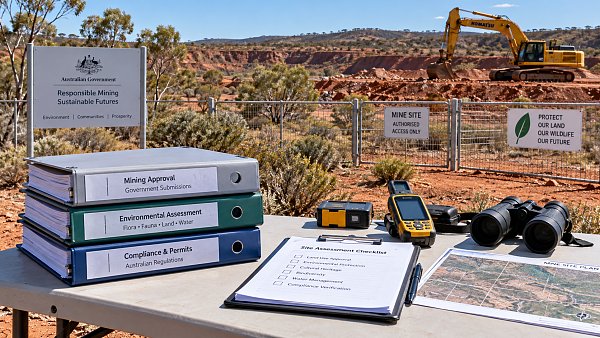
Australia: Australia combines national work health and safety principles with state- and territory-level mining legislation and regulatory practice. Western Australia, Queensland, New South Wales, and other jurisdictions have their own mining safety frameworks, and large operators frequently add demanding internal engineering standards. Australian Standards and joint AS/NZS standards are influential, particularly in electrical safety, mobile plant, functional performance, and risk management.
Australia is also notable for its mature approach to principal hazard management and verification. A machine may meet a technical standard but still require evidence that its controls work in the specific operational context: interaction with light vehicles, fatigue-management systems, autonomous zones, pit-edge controls, fire response, or underground ventilation constraints. For this reason, a compliance file that is sufficient for shipment may be insufficient for site mobilization.
European Union: In the EU, equipment placed on the market is shaped by the machinery legislation framework, applicable harmonized standards, and CE marking obligations. At the time of writing, the Machinery Directive 2006/42/EC remains applicable until 19 January 2027; the Machinery Regulation (EU) 2023/1230 applies from 20 January 2027. The transition matters for manufacturers planning product launches, significant redesigns, and technical documentation.
Mining equipment intended for potentially explosive atmospheres may also fall within the scope of the ATEX framework, including Directive 2014/34/EU for equipment and protective systems intended for use in potentially explosive atmospheres. ATEX classification, equipment category, temperature class, and installation assumptions must correspond to the actual zone classification at the mine. A CE mark by itself is not a universal statement that a machine is suitable for every underground or dust-hazard application.
United Kingdom: The UK has its own product-safety and workplace legal framework following its departure from the EU. In many cases, technical expectations remain closely aligned with established European practice, but conformity marking, market-access rules, and documentation need to be reviewed for the relevant Great Britain or Northern Ireland route. Treating the UK as simply another EU destination can create avoidable administrative and contractual errors.
South Africa and other African mining markets: South Africa’s Mine Health and Safety Act and associated regulations have major influence in one of the world’s most established mining jurisdictions. Legal compliance, mandatory codes of practice, risk assessment, and the role of competent persons are central considerations. Across Africa more broadly, requirements vary by country, enforcement capacity, and project ownership structure. International mining groups may apply Australian, South African, Canadian, ISO, or internal corporate standards alongside local law. This can create a “dual compliance” requirement: satisfy the host regulator while also meeting the owner’s global technical specification.
Latin America: Major mining countries such as Chile and Peru maintain national mine safety rules, inspection expectations, and operational requirements that must be assessed locally. Chile’s mining safety regulation, commonly referenced through Supreme Decree No. 132, is a significant framework for mine operations. In the region, equipment acceptance often depends not only on product certification but also on local engineering review, maintenance capability, Spanish-language documentation, and the mine’s own safety management system.
China and other Asian markets: China applies its own product, electrical, workplace safety, and mining regulatory requirements, including national GB standards in relevant areas. Depending on the product category and use case, local certification or testing obligations may arise. For imported machinery, the gap is often not limited to physical machine design; documentation, labeling, software interfaces, electrical components, and local service arrangements can all affect acceptance. Similar country-specific issues arise across Indonesia, India, Mongolia, Kazakhstan, and other resource-producing markets.
Does compliance with ISO standards make equipment globally acceptable?
No. ISO compliance is valuable, but it is not a global passport.
International standards help manufacturers establish a robust design basis. They improve comparability between bids, support risk assessment, and provide a common language for hazards such as crushing, entanglement, rollover, unintended movement, excessive noise, poor visibility, and maintenance access. They can also reduce the amount of redesign needed when a machine is exported.
However, ISO standards are generally voluntary unless adopted or referenced by legislation, contract, or a regulator. They do not automatically determine whether a product requires local electrical approval, third-party inspection, mine-specific authorization, or special controls for explosive atmospheres. In a dispute or incident investigation, the key question is usually whether the equipment complied with the applicable legal and operational requirements—not merely whether it was designed with reference to an international standard.
The same caution applies to CE marking. CE marking indicates conformity with applicable EU requirements for placing a product on the EU market. It does not prove compliance with MSHA rules, Canadian provincial requirements, Australian state mining regulations, or any other non-EU mine safety regime.
Which equipment categories create the greatest cross-border compliance risk?
Some assets are more likely than others to trigger redesign, additional testing, or protracted site acceptance.
- Underground diesel equipment: Exhaust emissions, fire suppression, braking, emergency egress, and ventilation interaction are closely scrutinized. Coal and gassy-mine applications create additional ignition-control issues.
- Electrical equipment for underground mines: Voltage, cable systems, earthing, flameproof or intrinsically safe protection, and local approval requirements can differ sharply.
- Battery-electric mobile equipment: Battery chemistry, thermal-event response, charging infrastructure, isolation, emergency procedures, and underground ventilation assumptions remain fast-moving regulatory and operational topics.
- Autonomous and remotely operated fleets: Functional safety, communications resilience, geofencing, interaction with people and conventional vehicles, cybersecurity, and takeover procedures are not regulated identically across markets.
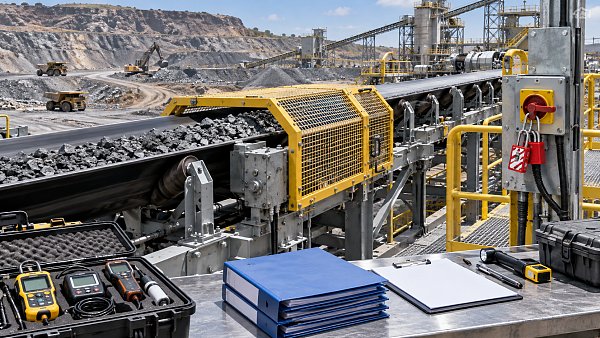
- Crushing, conveying, and processing plants: Guarding philosophy, emergency pull-wire systems, lockout arrangements, access platforms, dust control, and structural certification require close review, especially when a plant is assembled from multiple suppliers.
A recurring mistake is to focus on the primary machine while overlooking attached systems. A drill rig may be accepted, but its radio system, fire suppression package, electrical charger, telematics unit, lifting attachment, or operator-seat configuration may not meet local requirements. The compliance status of the integrated machine matters more than the status of individual components.
What should be reviewed before an international equipment order is placed?
The most useful starting point is a jurisdiction-specific compliance matrix tied to the actual mine, not just the destination country. It should identify the equipment’s intended use, mining method, operating environment, legal authority, applicable standards, required certificates, documents, inspections, and responsible party for each item.
That matrix should address at least the following questions:
- Is the machine for surface mining, underground hard-rock mining, coal mining, mineral processing, or a mixed-use area?
- Will it operate in a potentially explosive atmosphere or in a dust- or gas-sensitive environment?
- Which legal requirements apply to the machine, its electrical equipment, and its installation?
- Are local approvals required before shipment, before installation, or before commissioning?
- Which documents must be supplied in the local language, including manuals, risk assessments, electrical drawings, maintenance instructions, and training records?
- Do site standards exceed statutory minimums for fire suppression, collision avoidance, access, fatigue monitoring, telematics, or emergency shutdowns?
- Can replacement components be sourced with the same approval status throughout the machine’s operating life?
Contract language deserves equal attention. Purchase orders should define the applicable edition of standards, responsibility for evidence of conformity, change-control procedures, acceptance testing, remedies for nonconformity, and the treatment of regulatory changes between order placement and delivery. Vague wording such as “comply with all applicable standards” can be commercially dangerous when neither party has identified which standards apply.
Where do projects most often go wrong?
The costliest errors usually arise from late assumptions. One is assuming that the country of manufacture determines compliance requirements. It does not; the jurisdiction of use controls. Another is assuming that a certificate issued for a component applies to the assembled machine. It may not.
Projects also underestimate the difference between legal compliance and operational acceptance. A regulator may permit a machine, while the mine operator rejects it because the braking performance, access design, visibility package, fire system, or data interface does not meet its internal standard. Conversely, a technically superior machine can be delayed if the supplier cannot produce the required drawings, test records, declarations, local-language manuals, or approved spare-parts list.
For fleet owners, inconsistent regional configurations create a longer-term risk. Different brake systems, electrical components, emergency-stop arrangements, software versions, or safety interlocks complicate training, maintenance, inventory, and incident investigation. Standardizing globally where possible is economically sensible, but only after identifying the local deviations that cannot be designed out.
What is the practical conclusion for international mining projects?
Mining equipment safety standards do differ by country, but the real challenge is not simply managing different rulebooks. It is understanding how international design standards, national law, regional certification, regulator expectations, and mine-site controls interact for a particular machine and duty cycle.
Early technical due diligence is usually far cheaper than late modification. Before committing capital, project teams should validate the target jurisdiction, classify the operating environment, map mandatory approvals, compare them with the owner’s internal requirements, and preserve that analysis through design, shipment, commissioning, and lifecycle maintenance. In mining, safety compliance is not an accessory to procurement. It is part of the equipment specification, the project schedule, and the operating license to perform.
Recommended News
 Oct 22, 2026How import tariffs affect mining equipment procurement costsExplore mining industrial trade insights to see how import tariffs affect equipment costs. Compare landed costs, verify duty relief, and make smarter procurement decisions.
 Oct 19, 2026How to use trade insights to assess mining equipment import costsUse trade insights to assess mining equipment import costs, verify duties, compare freight routes, and uncover hidden charges. Build a reliable landed-cost estimate before you buy.
 Oct 21, 2026What Should a Mining Safety Compliance Pre-Audit Report Include?What should be included in a mining safety compliance pre-audit report? Discover essential scope, evidence, risk ratings, and corrective actions to strengthen inspection readiness.
 Oct 20, 2026Mining Regulations in Australia: Permits Required Before Site DevelopmentNavigate mining regulations in Australia with a practical guide to permits, land access, environmental approvals and safety obligations. Learn what to secure before development to avoid costly delays.