How to verify that packaging is food grade
To verify that packaging is food grade, establish whether the complete package is suitable for the specific food, contact conditions and destination market. Then check that the supplier’s compliance documents and supporting evidence cover that exact combination. A food-grade claim, a resin identification code or a generic certificate is not enough on its own.
For procurement teams, the most useful starting point is a written description of the intended use: what the package will contain, how it will be filled and stored, and where it will be sold. That description gives suppliers a basis for making a meaningful compliance declaration and gives buyers a way to identify gaps before placing an order.
Define the use before reviewing the paperwork
The same packaging material can be suitable for one application and unsuitable for another. A plastic container intended for cold, dry ingredients, for example, should not automatically be accepted for hot, oily food. Temperature, contact time and the nature of the food can affect the transfer of substances from packaging into food, known as migration.
Give the supplier a specification that covers the foreseeable conditions from filling through final use. At a minimum, include:
- Food type: Whether the contents are dry, aqueous, acidic, alcoholic or fatty, and whether they have features that could affect contact with the material.
- Contact conditions: Filling temperature, storage temperature, expected shelf life and any freezing, reheating, microwave or oven use.
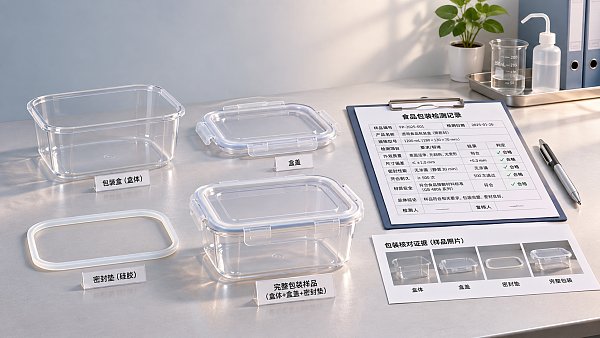
- Package configuration: The container, lid, liner, seal and any other component that could contact food directly or indirectly.
- Market: The countries where the packaged food will be placed on the market, including any customer-specific requirements.
- Operational use: Whether the package is single-use or reusable, and whether cleaning, abrasion or repeated heating is expected.
Be precise about boundaries. “Suitable for food” leaves too much open; “suitable for a fatty product filled hot and stored at ambient temperature for its intended shelf life” gives the supplier a use to assess. If the food will later be reheated in the package, that condition belongs in the request even if the packaging supplier never handles the finished product.
Check which rules apply in the destination market
Food-contact compliance is jurisdiction-specific. A document prepared for one market does not automatically establish compliance in another, and the legal requirements can differ by material. Ask the supplier to identify the legislation or other applicable requirements used for its assessment and to explain any limits on the declared use.
In the European Union, Regulation (EC) No 1935/2004 provides the general framework for materials and articles intended to contact food. Regulation (EC) No 2023/2006 addresses good manufacturing practice. Plastic food-contact materials are also subject to specific rules under Regulation (EU) No 10/2011, as amended, including requirements concerning authorized substances, restrictions and compliance documentation. Other materials may be subject to different EU or national provisions, so a plastic-specific declaration should not be treated as a complete assessment of a mixed-material package.
In the United States, the Food and Drug Administration regulates food-contact substances through several legal pathways. Depending on the substance and use, a supplier may rely on an applicable regulation, an effective Food Contact Notification, an exemption or another legally appropriate basis. Ask for the relevant basis and conditions of use rather than accepting “FDA approved” as a complete explanation.
An effective Food Contact Notification is generally specific to the notifier and its identified manufacturing or supply arrangements; it is not a blanket authorization for every supplier of a similarly named substance. A buyer should be able to connect the supplier’s material to the cited basis and confirm that the intended use falls within its conditions.
For other markets, request the applicable local assessment. Where packaging will be shipped to a processor in one country and the finished food sold in several others, the specification should identify all relevant destinations.
Read the declaration against the actual package
A declaration of compliance is one of the central documents in a purchasing review. For plastic materials and articles covered by the EU plastics regulation, a written declaration is required at specified stages of the supply chain. Elsewhere, the document’s form and legal status may differ, but a clear supplier statement remains useful evidence.
Check the declaration line by line against the item being purchased. It should identify the supplier and the product or material clearly enough to connect it to the order, cite the relevant requirements and state the uses for which compliance is claimed. Look for limits involving food type, temperature, contact duration or the way the article must be used. Check the issue date and whether the document is still applicable to the supplied formulation and manufacturing arrangement.
A declaration for a raw polymer does not necessarily cover a finished tub containing colorants, a printed lid, an adhesive and a seal. Likewise, a declaration for one container size or structure should not automatically be extended to another. Ask the supplier to explain the scope of the assessment and provide documentation for components that fall outside it.
Pay particular attention to restrictions that the buyer must carry forward. A packaging supplier may declare a material suitable only below a stated temperature or for specified food categories. If the buyer’s filling operation exceeds that boundary, the document does not support the intended application, even if it appears otherwise complete.
Declarations are also dependent on information supplied upstream. A converter may use evidence from resin, ink or adhesive suppliers without disclosing every formulation detail to the buyer. Commercial confidentiality is understandable, but it does not remove the need for a credible compliance assessment. Where detailed composition cannot be shared, agree on what supporting information can be reviewed, including whether a qualified independent party can assess confidential data.
Evaluate the evidence behind the claim
Ask what work supports the declaration: supplier assessments, calculations, migration testing or a combination of these. A test report can be valuable, but its title and pass result are only the beginning of the review.
Compare the tested sample with the package being purchased. Relevant differences can include material composition, layer structure, color, printing, closure and manufacturing process. A report on an unprinted film may not resolve questions about a printed laminate. A report for a container without its closure may leave the liner or seal unassessed.
Then examine the test conditions. Migration testing may use food simulants selected to represent classes of food under specified conditions. The chosen simulant, temperature and duration should be appropriate for the intended use or supported by a defensible assessment of more demanding conditions. A test designed around cold storage does not by itself demonstrate suitability for hot filling.
For regulated plastics, the assessment may involve overall migration, which measures the total amount of non-volatile substances migrating under specified conditions, and specific migration, which addresses individual substances subject to restrictions. A report covering one does not automatically answer every question about the other. The supplier should also explain how applicable restrictions and other relevant substances have been considered.
Check who performed the work and whether the report identifies the method, sample, conditions and results. Laboratory competence matters, but an accredited laboratory report is still only evidence for the sample and scope tested. It cannot compensate for a mismatch between the test and the intended application.
Testing every production batch for every possible substance is not necessarily the appropriate approach. The more useful question is whether the supplier can explain how its evidence supports the delivered article, including any calculations or assumptions. If the answer depends on a barrier layer, for instance, ask what establishes that the barrier performs as assumed throughout the intended use.
Look beyond the surface that touches food
The food-contact surface deserves close review, but the surrounding structure matters too. In multilayer packaging, substances can migrate through layers. Printing inks on the outside, adhesives between films and coatings on a closure may therefore be relevant to the assessment, even when they are not intended to touch the food directly.
Ask suppliers to identify the complete structure and explain how each relevant component has been assessed. For printed packaging, include the intended printing process and any potential for transfer from the printed surface to the food-contact surface during storage or conversion. A food-contact claim for the base film alone leaves those questions open.
Recycled content also needs a specific review. The source of the recycled material, the recycling process and applicable market rules can affect whether and how it may be used. Do not assume that a recycling symbol, a statement of recycled content or the identity of the original polymer establishes suitability for food contact.
For reusable packaging, ask how repeated use has been assessed. Cleaning chemicals, temperature, wear and repeated cycles can change the conditions of contact. The supplier’s instructions should be compatible with the buyer’s actual cleaning and handling process.
Separate compliance documents from certification claims
A supplier may hold a food-safety management or packaging-manufacturing certification. Such certification can provide useful information about systems, controls and audits, but it should be read for what it covers. Check the certificate’s scope, site, validity and issuing body, then compare them with the facility and product being purchased.
A site certificate does not, by itself, demonstrate that a particular package complies with every food-contact requirement for a particular food. Conversely, a declaration for a material does not establish that every batch will be manufactured consistently. The two types of evidence answer different procurement questions and should be reviewed together where both are relevant.
Common package markings have limits as well. A glass-and-fork symbol may indicate suitability for food contact, but it does not spell out every restriction on food type, temperature or duration. A resin identification code identifies a category of plastic for material identification purposes; it does not certify the formulation or finished article for a food application.
Close gaps before approving the order
When the documents do not match the use, ask a focused question tied to the gap. For example: “Does this declaration cover the printed lid and seal at our filling temperature?” or “What evidence supports contact with our fatty product for the stated shelf life?” A specific question is more likely to produce a usable answer than a general request for a food-grade certificate.
If the supplier’s evidence supports only part of the application, the buyer can consider changing the package, limiting the conditions of use or obtaining an additional assessment. The outcome should be recorded in the purchase specification and any quality agreement, including the approved product identity, supplier, conditions and required documents.
Set a process for changes after approval. A different resin grade, pigment, adhesive, recycled-content source, manufacturing site or package structure may affect the original assessment. Require the supplier to notify the buyer of relevant changes and provide updated evidence before the changed article is accepted. Retain declarations and supporting records with product and batch traceability so that the basis for approval can be retrieved if a question arises later.
The practical purchasing decision is straightforward: approve the package when the documented evidence connects the delivered article to the intended food, conditions of use and market requirements. If that connection cannot be made, resolve the specific gap before relying on the food-grade claim.
Recommended News
 Nov 12, 2026Can a helium shortage disrupt MRI scans?Discover the impact of helium shortage on MRI services, from potential scan delays to rising costs, and learn how hospitals can prepare.
 Nov 10, 2026How can AR support maintenance of mining equipment?Discover how AR supports mining equipment maintenance with guided inspections, remote expertise, and asset data—plus practical tips for a successful rollout.
 Nov 09, 2026How to verify that packaging is food gradeFood grade packaging verification starts with the right evidence. Learn how to check supplier declarations, migration tests and market requirements before you buy.
 Nov 06, 2026How to choose tech accessories for remote workChoose tech accessories that make remote work more comfortable and productive. Explore practical tips on headsets, monitors, docks, connectivity, and security.