Are Heavy Machinery Performance Benchmarks Unified Across Regions?
Heavy machinery performance benchmarks are only partly unified across regions. International standards establish common methods for measuring selected characteristics, including engine power, sound emissions, and some machine capabilities. They do not create a single worldwide rating for productivity, reliability, or operating cost. Regional regulations, equipment configurations, and site conditions still affect what a published result means.
A performance claim becomes comparable when its measurement method, machine configuration, and operating conditions are sufficiently aligned. Two excavators with similar rated power can deliver different excavation rates; two haul trucks carrying the same payload can consume different amounts of energy over different routes. The useful question is therefore whether a particular benchmark measures the same outcome under conditions relevant to the intended application.
Where international benchmarks provide common ground
Standardized test procedures make individual specifications easier to interpret across markets. A defined engine-power test establishes the measurement basis and reference conditions. A sound measurement procedure specifies how the result is obtained. Equipment-specific methods also support comparisons of characteristics such as lifting capacity or digging force, provided the relevant configuration and test arrangements are disclosed.
However, the statement “tested to an international standard” is incomplete without identifying the method, edition, and reported quantity. Gross and net engine power are different measurements. Sound power and sound pressure are different quantities. A lifting rating measured at one radius and height cannot be transferred directly to another working position.
The scope of standardization matters as much as the standard itself. A standardized component measurement does not establish whole-machine performance. Engine output alone cannot predict excavator production because hydraulic efficiency, attachment geometry, material resistance, and cycle timing intervene between the engine and the finished work.
International methods therefore provide a shared technical vocabulary. Comparability still requires matching the particular measurement and its boundary. Even identical method names deserve closer examination when results come from different editions, optional test arrangements, or differently equipped machines.
Regional compliance changes the comparison
Regulatory conformity and performance benchmarking answer separate questions. Conformity establishes whether equipment satisfies applicable requirements in a jurisdiction. Benchmarking measures how it performs under stated conditions. A machine approved for one market does not automatically satisfy another market’s requirements, and its approval does not prove superior productivity.
Emissions requirements illustrate the distinction. Engines supplied to different markets can use different emissions-control configurations. Exhaust aftertreatment introduces operating considerations such as regeneration behavior, additional consumables, and maintenance requirements. Any effect on fuel consumption or availability must be assessed over the relevant duty cycle; the emissions designation alone does not establish that effect.
Underground operation creates additional boundaries. Ventilation demand, exhaust characteristics, fire protection, and requirements for particular hazardous environments influence which configurations are suitable. A surface-duty performance result does not resolve underground suitability, even when the basic machine model is the same.
Safety equipment also affects the configuration being compared. Protective structures, guarding, fire-suppression equipment, and other site-required additions can change operating mass or maintenance access. Regional versions carrying the same model designation should therefore be treated as separate configurations until their specification differences are understood.
Site conditions can outweigh regional labels
Geography is an imperfect substitute for operating conditions. Two mines in the same country can impose very different demands, while sites on different continents can have closely comparable duty cycles. Altitude, ambient temperature, ground conditions, and material characteristics explain performance differences more directly than a regional label.
At altitude, available engine output depends on the engine’s compensation capability and operating limits. High temperatures place additional demands on cooling systems. If thermal protection reduces output during sustained work, a short demonstration can overstate the production achievable over a full shift. Temperature, elevation, and the duration of continuous loading belong alongside the reported result.
For haulage, route geometry is fundamental. Loaded uphill travel, empty return travel, rolling resistance, speed restrictions, and queuing all contribute to cycle time. Retarding capability and thermal limits affect descent performance. A truck benchmark from a level haul road cannot establish productivity on a route dominated by long gradients.
Material properties create equally significant differences. Loose bulk density changes the relationship between bucket volume and payload. Fragmentation affects bucket filling and crusher throughput. Abrasiveness changes wear rates, while moisture and clay content influence flow and blockage behavior. Tonnes per hour without a material description leaves too much of the test unexplained.
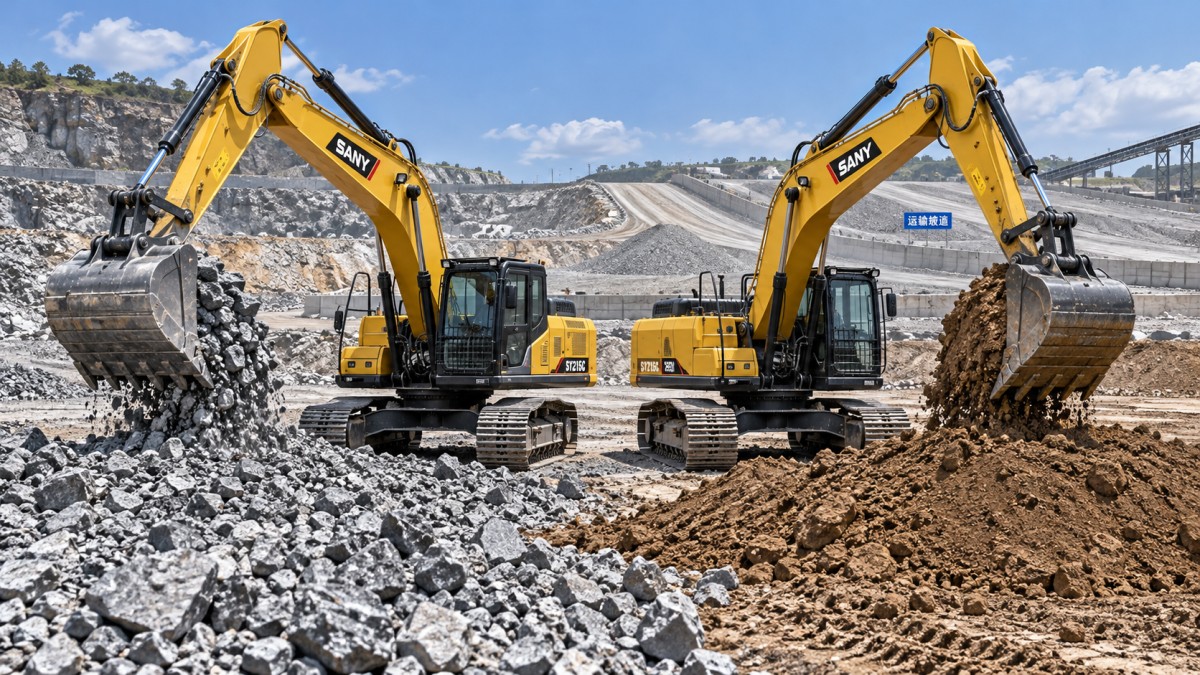
Consider two excavator trials using the same nominal bucket capacity. One handles loose, well-fragmented material; the other digs compact material with large inclusions. Different filling resistance and bucket fill produce different payloads and cycle times. Assigning the production gap to regional machine quality would ignore the variables that directly produced it.
The denominator often changes the ranking
A benchmark’s denominator determines which question it answers. Fuel consumption per engine hour describes the rate of fuel use. Fuel consumption per tonne relates consumption to material output. Fuel per tonne-kilometre also includes transport distance. These measures cannot be substituted for one another without the supporting production and route data.
A machine with higher hourly fuel use can consume less fuel per tonne if its additional output exceeds the increase in consumption. Conversely, a low hourly consumption figure can reflect substantial idle time. Reporting both the consumption rate and the useful output makes that difference visible.
Time definitions create another source of disagreement. Excavator production measured during uninterrupted loading differs from shift production that includes truck positioning, refueling, inspections, and delays. Both measurements are useful, but they describe different operating boundaries. Removing delays from one result while retaining them in another distorts the comparison.
Processing equipment requires a similar distinction between feed and acceptable output. Crusher throughput measured as feed tonnes per hour does not establish production of material meeting the required size distribution. Recirculating loads and changes in feed characteristics affect the relationship. A higher throughput result loses its advantage if it produces material outside the specified requirement.
Electric equipment needs an explicit energy boundary
Battery-powered machinery introduces several possible measurement points: electricity drawn from the supply, energy delivered by the charger, and energy discharged from the battery. Each describes a different boundary. Comparing a battery-discharge figure with a grid-input figure excludes charging losses from one side of the comparison.
Regenerative braking also depends on the route. A descent with a loaded vehicle presents a different recovery opportunity from an empty descent. Battery temperature, state of charge, and charging interruptions influence usable operating time. A regional electricity mix is relevant to emissions accounting, but it does not change the measured electrical energy required to complete the same task.
Reliability figures require shared accounting rules
Availability is especially difficult to compare across regions because organizations define it differently. Mechanical availability, operational availability, and utilization describe distinct aspects of equipment performance. A machine can be mechanically ready while remaining unused because no truck is available, a downstream plant is stopped, or the work area is inaccessible.
A reported availability percentage needs its formula and time categories. The calculation must show whether planned maintenance is excluded, how standby time is treated, and when a downtime event begins and ends. Without those definitions, similar percentages can conceal different levels of service.
Repair duration also reflects the support environment. Diagnostic access, replacement-part availability, workshop capacity, and transport time influence restoration. Failure frequency addresses how often faults occur; repair time addresses how long recovery takes. Combining them into one availability figure conceals whether the limitation comes from machine reliability or restoration arrangements.
Long-term comparisons additionally require exposure data. Accumulated operating hours, machine age, workload, maintenance practices, and recorded failure categories provide context for reliability claims. Results from newly commissioned equipment do not establish performance later in its service life. Regional comparisons need comparable populations, rather than one favorable machine from each location.
Turning regional results into a defensible comparison
A useful comparison begins with a defined task: move material along a specified route, excavate a stated material, or produce an acceptable processed output. That task determines which measurements matter. Nameplate specifications then support the evaluation without substituting for the operating result.
The evidence should distinguish standardized test data, controlled field measurements, and modeled estimates. These sources have different strengths. Controlled measurements describe observed performance within the test conditions. Models extend an assessment to other conditions through assumptions that need to remain visible.
Normalization can improve comparability when the adjustment has a valid engineering basis. Unit conversions are straightforward. Adjustments for payload, gradient, temperature, or material properties require appropriate relationships and supporting data. Applying a broad regional correction factor conceals site-specific differences.
For substantial differences, a common field protocol offers stronger evidence. It should establish the configuration, material, route or work sequence, measurement instruments, and delay categories before the trial. Runs across representative conditions reveal whether an apparent advantage persists beyond one favorable cycle. Instrument calibration and missing-data treatment also affect the credibility of the result.
Where lifecycle cost is compared, the same discipline applies. Fuel or electricity prices, maintenance assumptions, service life, and production output must use a consistent basis. Local prices belong in the commercial scenario; equipment consumption and maintenance quantities should remain separately identifiable. Otherwise, a regional price advantage can be mistaken for better technical performance.
A cross-region benchmark is defensible when its measurement boundary, configuration, and operating conditions are transparent enough to reproduce or reasonably adjust. If those details are missing, the appropriate result is an unresolved comparison. International standards narrow the uncertainty, while comparable operating evidence determines whether the claimed advantage transfers to the actual work.
Recommended News
 Oct 22, 2026How import tariffs affect mining equipment procurement costsExplore mining industrial trade insights to see how import tariffs affect equipment costs. Compare landed costs, verify duty relief, and make smarter procurement decisions.
 Oct 19, 2026How to use trade insights to assess mining equipment import costsUse trade insights to assess mining equipment import costs, verify duties, compare freight routes, and uncover hidden charges. Build a reliable landed-cost estimate before you buy.
 Oct 22, 2026Are Heavy Machinery Performance Benchmarks Unified Across Regions?Are there unified benchmarks for heavy machinery performance across regions? Explore global standards, regional differences, and key metrics to make smarter equipment comparisons.
 Oct 21, 2026What Should a Mining Safety Compliance Pre-Audit Report Include?What should be included in a mining safety compliance pre-audit report? Discover essential scope, evidence, risk ratings, and corrective actions to strengthen inspection readiness.