Matching Bucket Chain Diamond Dredger Capacity to Deposit Conditions
Capacity selection for a diamond dredger begins with the deposit, not the brochure. A machine that appears large enough on the basis of hourly material handling can still underperform if the digging depth is wrong, the gravel contains too much oversize, the recovery circuit is poorly matched to the diamond size distribution, or the hull cannot remain stable in the intended water conditions.
For technical evaluators, the practical question is not simply “How many cubic metres per hour can the dredger process?” It is whether the complete excavation, screening, concentration, tailings, power, and mooring system can work at a steady rate on the material actually present. Capacity is a system outcome. The weakest stage—often bucket filling, clay breakdown, screening, or recovery-water management—sets the usable production rate.
Start with a deposit model rather than a nominal throughput target
Before comparing dredger configurations, the project team should convert exploration and sampling information into an operational deposit model. This model does not need to predict every metre of the mining area, but it should describe the conditions that materially affect the dredging circuit.
Useful inputs include:
- Pay-gravel thickness, overburden thickness, and expected bedrock profile;
- Water depth, seasonal water-level variation, current, wave exposure, and access limitations;
- Particle-size distribution of gravel, sand, cobbles, boulders, and clay-bound material;
- Clay content and the tendency of fines to form balls or coatings around larger stones;
- Bulk density, moisture condition, and the presence of compacted layers;
- Expected diamond size range, shape, liberation condition, and association with specific horizons;
- Waste-to-ore ratio and the location where tailings can be safely deposited or reclaimed.
A deposit containing free-running sand and rounded gravel presents a very different duty from a shallow palaeochannel with cemented gravel, large boulders, and sticky clay. The first may be limited by recovery-circuit throughput. The second may be limited by bucket digging force, chain wear, grizzly opening, and the time required to clear oversize material. Treating both as the same “alluvial diamond” application can lead to an unsuitable machine specification.
How bucket-chain capacity is created in real operation
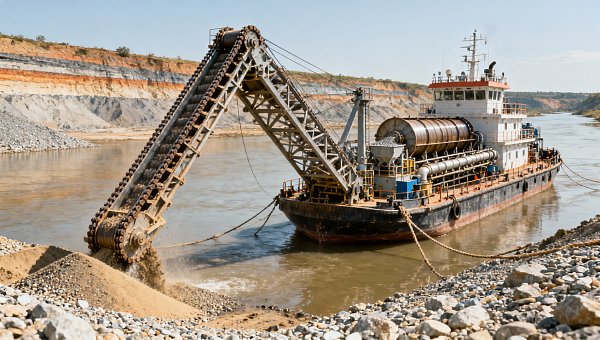
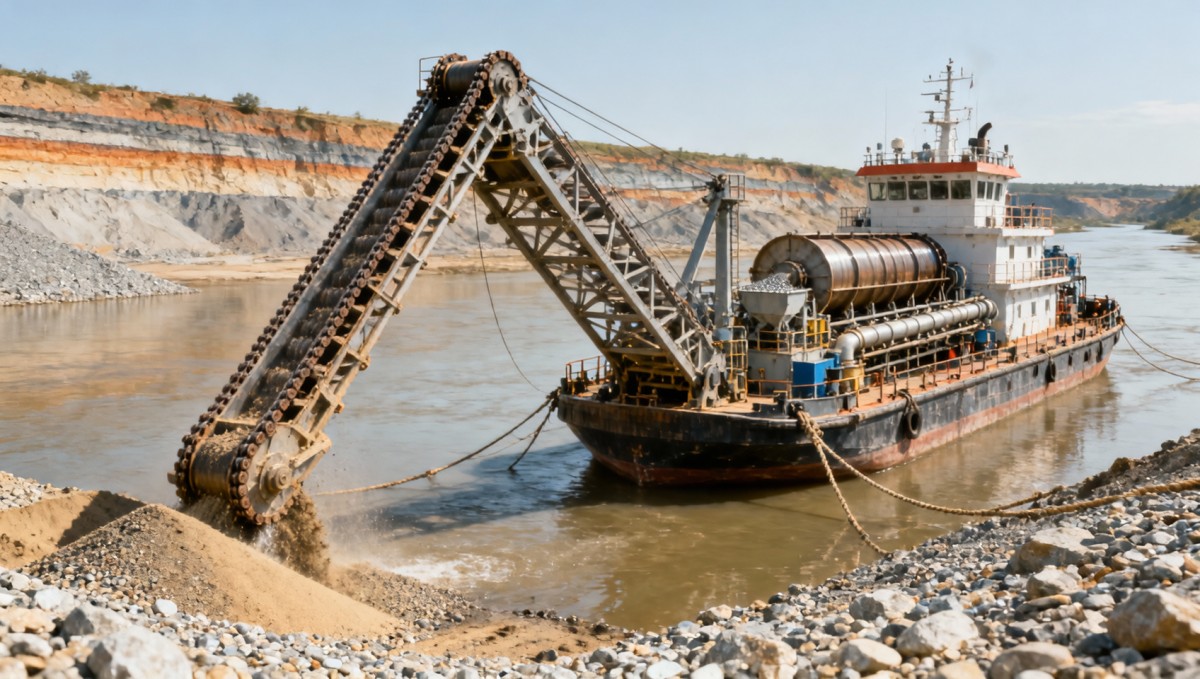
A bucket-chain dredger excavates continuously as buckets travel around the ladder, lift material from the face, and discharge it into the feed preparation and recovery system. Nominal capacity is influenced by bucket volume, bucket spacing, chain speed, filling factor, ladder angle, digging depth, and the material’s resistance to excavation. None of these variables should be assessed in isolation.
Bucket volume multiplied by chain speed may suggest an impressive theoretical handling rate. Yet buckets rarely achieve full, clean filling in difficult ground. Underfilled buckets can result from coarse voids in boulder-rich gravel, material rolling out during lift, an unsuitable digging angle, or inadequate penetration into a compacted face. Overfilling can also be a problem if the discharge chute, trommel, or feed hopper cannot accept the material without spillage and surging.
The required ladder depth should include more than the average water depth. Technical reviews should account for the lowest expected working water level, the thickness of overburden, the target pay horizon, bedrock irregularity, and a reasonable allowance for controlled cleaning of the bedrock contact. If the ladder reaches only the average depth, the dredger may leave potentially mineralized gravel in deeper pockets or become dependent on favourable seasonal water conditions.
Digging depth also affects hull stability, ladder loading, winch demand, and power requirements. A longer ladder may expand the mineable envelope, but it adds structural load and can make control more difficult where currents or wind push the hull off position. The relevant evaluation is the safe working depth across the expected operating area, not the maximum depth quoted for an ideal, calm-water condition.
Match the excavation train to the gravel characteristics
The bucket chain should be selected around the hardest expected material interval, not solely the most easily dredged portion of the deposit. Where coarse gravel and cobbles are frequent, evaluators should review bucket lip construction, wear protection, chain links, pins, rollers, sprockets, ladder structure, and access for replacement work. Abrasion is not only a maintenance cost; it can reduce production when worn parts alter bucket filling or trigger unplanned stoppages.
Oversize is particularly important. Large cobbles can bridge at a grizzly, block a chute, damage a trommel feed zone, or overload a downstream conveyor. A plant may have enough nominal capacity for average feed but still lose substantial operating time if the oversize rejection route is poorly designed. Questions for the design review include:
- What is the largest expected rock size, and how was that estimate obtained?
- Can the bucket opening accept that material without frequent jamming?
- Where is oversize separated, and can it be removed without interrupting the main feed?
- Will rejected oversize be placed where it obstructs dredger movement or future mining?
- Is there a practical method for clearing a blockage without exposing personnel to suspended loads or moving machinery?
Clay creates a different constraint. Sticky clay can pass through the buckets but remain as lumps through the primary screen, trapping diamonds and reducing the effectiveness of separation equipment. Increasing bucket-chain speed may simply send more poorly prepared material into the recovery plant. In clay-rich deposits, a scrubber, washing section, spray arrangement, longer retention time, or a lower and steadier feed rate may be more valuable than a larger excavation capacity.
Recovery capacity must protect the expected diamond population
Diamond dredging is not a bulk-aggregate operation. The processing circuit must handle the feed rate while preserving the conditions needed to recover the expected diamond fraction. This requires attention to screen apertures, classification cuts, particle-density separation, water flow, concentrate handling, and final sorting procedures. Any recovery design must be assessed against representative mineralogical and size-distribution information, where available.
A common planning error is to set the dredging rate from the maximum feed capacity of the screen or trommel. That approach ignores recirculating load, variable clay content, oversize interruptions, and the capacity of concentrate clean-up. If the recovery section becomes overloaded, the immediate result may be loss of separation quality rather than a visible mechanical failure. This is why operating tests should include difficult material samples, not only clean sand and gravel.
When assessing a bucket chain diamond dredger, the technical file should show how the excavation rate is intended to relate to the screening and recovery stages. A product layout can be a useful starting point, but project fit depends on verified dimensions, process flow, power distribution, wear-package choices, and the deposit-specific recovery design. The same base dredger arrangement may require different bucket sizes, screening arrangements, or auxiliary equipment for different mining areas.
Evaluate capacity as a range, with defined operating conditions
A defensible procurement specification should request a capacity range rather than accepting one unqualified output figure. The range should identify the material condition behind each value: estimated gravel grading, expected bucket filling factor, planned screen opening, assumed water availability, and the proportion of time allowed for repositioning, clearing oversize, and maintenance.
Hull, mooring, and water conditions can become the real bottleneck
Even a well-matched excavation and processing train cannot maintain output if the dredger cannot hold position accurately. Mooring design should reflect current direction, water depth, shoreline geometry, anchor conditions, and the planned mining sequence. A system designed only for still water may require frequent corrections in a river channel, reducing face control and increasing wear on the bucket chain.
The hull should be reviewed for flotation reserve, compartment arrangement, deck loading, access routes, and stability under working ladder loads. Technical evaluators should request the design basis used for buoyancy and stability calculations rather than treating hull dimensions as sufficient evidence. Where the dredger will be transported in sections, the joining method, lifting points, transport weights, and reassembly tolerances also deserve review. A design that is practical to fabricate may still be difficult to mobilize to a remote site.
Water supply and water quality matter downstream. Screens and recovery equipment may require process water at a stable pressure and volume. Silt-laden water can accelerate wear in pumps and spray systems, while limited water availability can restrict washing performance. If recycled process water is planned, the design should address settling, solids management, pump protection, and the effect of accumulated fines on separation conditions.
Assess a China-built dredger through documentation and verification
Country of manufacture should not replace technical due diligence. For a China-built bucket-chain dredger, the review should focus on whether the supplier can provide consistent engineering documentation, material traceability where specified, fabrication records, electrical information, inspection evidence, and a clear scope boundary for supplied and site-provided equipment.
Factory acceptance should be planned around components that can be checked before shipment. Depending on the scope, this may include confirmation of major dimensions, drive alignment, chain movement, gearbox and motor identification, control-panel wiring, pump rotation, weld inspection records, and the completeness of spare parts. A dry factory test cannot reproduce excavation in an actual diamond-bearing deposit, so it should not be presented as proof of recovery performance. Its value is in detecting assembly, electrical, mechanical, and documentation issues before mobilization.
Where machinery safety requirements apply, the project should define the governing jurisdiction and contractual responsibilities early. ISO 12100 provides a recognized framework for machinery risk assessment and risk reduction; ISO 13849-1 addresses safety-related parts of control systems; IEC 60204-1 covers electrical equipment of machines. These standards do not automatically establish legal compliance in every location, but they can help structure a design review. Sources: ISO Online Browsing Platform, ISO 12100:2010 and ISO 13849-1:2023; International Electrotechnical Commission, IEC 60204-1:2016.
Turn selection into a staged project-fit decision
The strongest evaluation process separates what is known from what is assumed. Deposit data should be ranked by confidence, with particular attention to bedrock depth, oversize frequency, clay behaviour, and diamond size distribution. The equipment supplier can then be asked to state the operating assumptions behind the proposed dredger capacity. Differences between those assumptions and the project evidence should be visible in the technical comparison, not buried in general correspondence.
A staged approach is often more reliable than selecting solely by the largest quoted capacity. Confirm the mineable depth envelope, establish a realistic feed-rate range, check the recovery circuit against representative material, review wear exposure, and verify that the hull and mooring arrangement suit the water body. The selected configuration should retain enough operating margin for variable ground conditions. In diamond dredging, stable and controlled treatment of the right material is generally more valuable than a high theoretical excavation rate that cannot be sustained at the face.
Recommended News
 Sep 29, 2026Matching Bucket Chain Diamond Dredger Capacity to Deposit ConditionsBucket chain diamond dredger capacity depends on deposit depth, gravel size, clay content, recovery needs, and water conditions. Learn how to select a reliable, high-performing configuration.
 Sep 24, 2026When do electric vehicles in agriculture reduce operating costs?Electric Vehicles in agriculture reduce costs when duty cycles, charging, maintenance, and uptime align. Explore practical procurement insights for smarter farm fleets.
 Sep 09, 2026How to measure mine soil remediation performance after treatmentMine soil remediation performance: learn how to verify chemical, physical, water and biological outcomes for reliable, audit-ready mine closure.
 Sep 02, 2026Which Green Mining Certifications Should Equipment Buyers Look for in 2026?What green mining certifications should equipment buyers look for in 2026? Explore ISO standards, emissions compliance, battery safety, lifecycle data, and sourcing proof.