When do electric vehicles in agriculture reduce operating costs?
When Do Electric Vehicles in Agriculture Reduce Operating Costs?
Electric vehicles in agriculture can reduce operating costs when duty cycles, charging access, energy prices, and maintenance requirements align with the farm’s real workload. For procurement teams, the decision is not simply about replacing diesel equipment. It is a total-cost-of-ownership question involving productive hours, charging infrastructure, battery life, operator behaviour, service coverage, and the cost of downtime during a narrow planting or harvest window.
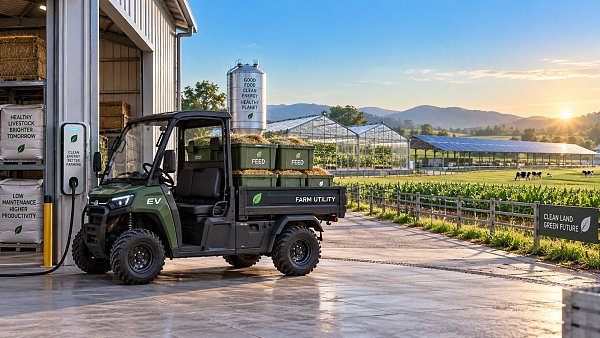
The strongest business case is usually found in predictable, repeatable work: transport between farm buildings, feeding and livestock routines, orchard operations, greenhouse logistics, municipal-style grounds work, and short-haul material movement. The economics become less certain when an electric machine must pull heavy implements continuously, travel long distances between dispersed fields, or operate without dependable access to charging.
A lower fuel bill is only one part of the calculation. A useful procurement review asks a harder question: can the electric asset deliver the required work at the required time, at a lower lifecycle cost and with an acceptable operational risk profile?
The Cost Advantage Starts With the Duty Cycle
Electric drivetrains are generally most compelling where equipment returns to a known base, operates within a bounded area, and has natural idle periods. A utility vehicle used for daily inspections, fencing repairs, livestock checks, tool transport, or movement around a packhouse may complete its work without exhausting its available battery capacity. If it can recharge overnight, the operation avoids the need for a large daytime charging buffer.
That pattern matters more than the vehicle’s advertised range. Published range values can vary substantially with terrain, payload, weather, tyre selection, driving style, power-take-off demand, and battery age. A procurement decision should therefore use an observed duty profile rather than a brochure number. Record start and finish locations, hours under load, travel distance, stops, average payload, peak draw events, and seasonal changes in workload.
A compact electric tractor or utility vehicle may make economic sense for repetitive light-to-medium work, yet be poorly suited to the farm’s highest-load task. This does not make the purchase unsuccessful. It may indicate that a mixed fleet is the sensible answer: electrify stable, lower-energy work first while retaining diesel or other high-energy equipment for sustained tillage, heavy haulage, remote-field access, or contingency operations.
Where the operating profile is usually favourable
- Daily routes begin and end at the same farmyard, depot, shed, or packing facility.
- Loads are consistent and do not routinely push the machine close to its maximum tractive or hydraulic demand.
- Equipment spends time parked between shifts, allowing managed charging without interrupting productive work.
- Noise, exhaust emissions, or indoor air quality create practical constraints around barns, greenhouses, food-handling areas, or worker facilities.
- The existing diesel fleet has significant maintenance exposure from idling, frequent short trips, or stop-start operation.
Conversely, an electric machine becomes harder to justify if it must cover unpredictable distances, operate for long shifts with no charging opportunity, or support a task where a delayed refuel is inconvenient but a charging interruption would stop production. The cost of one missed irrigation, harvest, spraying, or feed-delivery window can outweigh a year of energy savings.
Energy Cost Is About Charging Design, Not Just Electricity Price
Electricity can be less expensive and less volatile than diesel on a unit-of-work basis, but that outcome depends on how energy is purchased and delivered. Charging from an existing site connection during lower-demand periods is a very different proposition from installing major electrical upgrades solely to support a small fleet. The capital required for transformers, switchgear, cable runs, charging equipment, civil work, permits, and load management can change the economics materially.
Procurement teams should distinguish between energy consumption and charging infrastructure. The vehicle may consume relatively little energy, while the site still requires an expensive upgrade because several machines need to charge simultaneously. Staggered charging, controlled overnight schedules, and realistic fleet utilisation can sometimes reduce the required peak capacity. These are operational design decisions, not afterthoughts for the facilities team.
On farms with on-site generation, the question is also more nuanced than “solar power is free.” Generation timing, storage, seasonal output, export arrangements, and the competing energy demands of pumps, refrigeration, grain handling, workshops, or accommodation all need consideration. A battery vehicle may absorb locally generated electricity at useful times, but the financial value must be assessed against other loads and local tariff structures.
Maintenance Savings Are Real Only If Service Support Is Real
Electric propulsion eliminates or reduces several conventional maintenance demands, including engine oil changes, exhaust after-treatment issues, and some drivetrain components. For equipment with frequent low-speed, stop-start operation, this can be a meaningful operational benefit. Fewer routine mechanical service tasks may also improve availability where workshop labour is limited.
But “lower maintenance” should not be translated into “maintenance-free.” Agricultural equipment still faces mud, dust, vibration, washdown, corrosion, hydraulic wear, tyre damage, bearing failures, electrical connector deterioration, and operator-related damage. High-voltage systems introduce different inspection and repair requirements. The supplier’s ability to diagnose faults on-site, provide approved technicians, and hold critical parts locally is often more important than a headline claim about fewer moving parts.
Battery terms deserve close reading. Procurement should establish what the warranty covers, how battery condition is measured, what operating practices may affect coverage, and whether replacement lead times are defined. It is also worth checking whether the battery is owned, leased, removable, or integrated into the vehicle. These arrangements affect accounting treatment, repair responsibility, residual-value assumptions, and the practical options available late in the asset’s life.
The Purchase Price Can Mislead Both Ways
An electric agricultural vehicle may have a higher initial acquisition cost than an equivalent diesel unit. Looking only at purchase price can therefore reject a viable project before operating savings, maintenance, emissions requirements, and infrastructure are considered. The opposite error is equally common: a low projected energy cost is used to justify equipment that needs oversized charging assets or cannot sustain the required daily duty cycle.
A credible evaluation should compare alternatives over the organisation’s intended ownership period. Include acquisition, financing where relevant, infrastructure, energy, planned maintenance, consumables, insurance, training, downtime exposure, expected resale value, and any site-specific compliance cost. Keep the assumptions visible. A model that cannot explain its input assumptions is not a procurement tool; it is a sales estimate.
Sensitivity testing is particularly useful. Test what happens if electricity costs rise, diesel costs fall, the vehicle completes fewer annual hours than expected, battery performance is reduced in cold conditions, or an extra charger is required. If the economic case remains acceptable across realistic variations, the investment is more resilient. If it works only under one optimistic set of assumptions, a pilot deployment may be wiser than fleet-wide replacement.
Productivity Must Be Measured in Completed Work
Comparing motor power or battery capacity alone does not establish operational equivalence. Agricultural work is governed by drawbar pull, hydraulic requirements, attachment compatibility, ground conditions, travel speed, lifting cycles, operator visibility, and the ability to continue through a full shift. A machine that is inexpensive to run but cannot pull the required implement at the needed speed may increase labour hours and reduce throughput.
The better metric is completed work per shift: hectares covered, loads moved, animals served, tonnes handled, inspection routes completed, or hours of productive attachment use. This should be measured under representative conditions, not only during a short demonstration on firm ground. Trial work should include slopes, wet conditions where appropriate, realistic payloads, cold starts, and the actual attachments used by the farm.
Autonomous and semi-autonomous electric fleets introduce another layer. They may reduce labour demand in highly repeatable tasks, but the business case depends on supervision, geofencing, communications reliability, field mapping, safety procedures, and recovery plans when equipment stops. Automation should not be used to hide an inadequate energy or charging plan.
Risk Controls Matter More in Seasonal Operations
Agriculture has little tolerance for avoidable downtime at critical moments. A farm may accept slower charging during ordinary weeks but not during a weather-dependent harvest or a high-intensity planting period. The procurement specification should therefore include continuity requirements: backup equipment, charger redundancy where justified, emergency access to alternative transport, response-time commitments, and procedures for operating safely after a fault.
Electrical installation should be reviewed against applicable local rules and site conditions rather than treated as a generic plug-and-play exercise. Outdoor exposure, dust, moisture, livestock access, vehicle impact risk, cable routing, fire separation, and emergency isolation arrangements all affect the installation. Requirements may also differ by jurisdiction, insurer, and the nature of the facility.
This is where heavy-equipment benchmarking disciplines are useful beyond mining and construction. G-MRH’s work across zero-emission fleets, duty-cycle assessment, equipment reliability, and lifecycle cost optimisation points to a transferable principle: technology performance must be judged in the operating environment, not in isolation. A vehicle, charger, electrical system, maintenance plan, and work schedule form one operating system.
A Practical Procurement Sequence
Before issuing a request for quotation, classify fleet tasks by energy intensity and operational criticality. Identify the jobs that are predictable, return-to-base, and non-negotiable in timing. Those are often the right candidates for early electrification. Then gather at least several weeks of utilisation data where seasonality permits, rather than relying on operator recollection alone.
Ask suppliers to state performance boundaries, not only ideal operating claims. Clarify payload assumptions, attachment limits, charging method, operating temperature range, battery warranty conditions, ingress protection relevant to the site, service intervals, diagnostic access, and local parts support. If a supplier cannot specify what conditions reduce performance, it will be difficult to build a defensible cost model.
A monitored pilot can be more valuable than a broad initial rollout. Track energy use, charging duration, productive hours, unplanned downtime, maintenance events, operator feedback, and whether the machine actually replaces diesel work rather than merely adding another asset to the fleet. The result should inform the next procurement cycle, including charger sizing and fleet segmentation.
The Point at Which Savings Become Credible
Electric vehicles in agriculture reduce operating costs most reliably when they replace high-frequency diesel work with a stable, measurable routine; charge where and when the farm can support it; and receive service support suited to commercial uptime requirements. They are less compelling when range uncertainty, heavy continuous load, remote operations, or costly grid upgrades dominate the decision.
The right conclusion may be partial electrification rather than complete replacement. A well-matched electric utility vehicle, compact tractor, or autonomous platform can remove fuel and maintenance costs from selected tasks while preserving conventional equipment for the hardest duty cycles. Before committing capital, validate the work profile, charging plan, infrastructure scope, supplier support, and seasonal fallback arrangements. That is where an operating-cost claim becomes a procurement decision that can withstand real farm conditions.
Recommended News
 Sep 24, 2026When do electric vehicles in agriculture reduce operating costs?Electric Vehicles in agriculture reduce costs when duty cycles, charging, maintenance, and uptime align. Explore practical procurement insights for smarter farm fleets.
 Sep 09, 2026How to measure mine soil remediation performance after treatmentMine soil remediation performance: learn how to verify chemical, physical, water and biological outcomes for reliable, audit-ready mine closure.
 Sep 02, 2026Which Green Mining Certifications Should Equipment Buyers Look for in 2026?What green mining certifications should equipment buyers look for in 2026? Explore ISO standards, emissions compliance, battery safety, lifecycle data, and sourcing proof.
 Aug 30, 2026How low-waste packaging machinery reduces material lossSustainable packaging machinery low waste strategies reduce film, bag, and carton loss while protecting industrial loads. Explore smarter controls, data, and proven evaluation steps.