Can IP67 waterproof signage withstand permanent submersion?
Can IP67 waterproof signage withstand permanent submersion? The short answer is no: an IP67 rating indicates protection against temporary immersion under specified test conditions, not continuous underwater use. For technical evaluators selecting signage for mines, processing plants, or other demanding industrial sites, this distinction matters. Understanding the test limits, operating environment, and manufacturer’s specifications can help prevent premature failure and support a more reliable procurement decision.
That answer does not mean every IP67 sign will fail as soon as it remains underwater beyond the test period. It means the rating alone does not establish suitability for that duty. A sign mounted near a sump may spend years exposed to splashes and occasional flooding; a sign fixed below the normal waterline has a fundamentally different operating requirement.
What the IP67 rating actually demonstrates
Ingress protection ratings are defined by IEC 60529. In IP67, the first digit, 6, indicates a dust-tight enclosure under the standard’s test conditions. The second digit, 7, indicates protection against the effects of temporary immersion in water under specified conditions. These are enclosure protection classifications, not statements that every component inside the enclosure will tolerate any environment.
For the standard IPX7 immersion test, the duration is 30 minutes. The enclosure is positioned so that its lowest point is 1 metre below the water surface or its highest point is 0.15 metres below the surface, whichever results in the greater depth. That detail matters for larger enclosures: the familiar shorthand “one metre for 30 minutes” does not describe the positioning requirement in every case.
The assessment is made against the relevant acceptance criteria in IEC 60529 and, where applicable, the product standard. It is not a general promise that no moisture can ever enter, that the graphics will remain readable indefinitely, or that the assembly will survive chemicals, impact and ultraviolet exposure. Those are separate questions.
The edition of the standard and any applicable product-specific requirements should be identified in the supplier’s documentation. A catalogue claim is a useful starting point, but it is not a substitute for knowing what configuration was assessed.
Why a temporary immersion test is not a service-life test
A new enclosure can pass a controlled immersion test and still be a poor choice for years of underwater service. In the field, seals age, fasteners relax, surfaces collect deposits and maintenance teams open covers. Temperature changes can also create pressure differences across an enclosure, while a cable may transmit moisture toward a termination if the sealing arrangement is unsuitable.
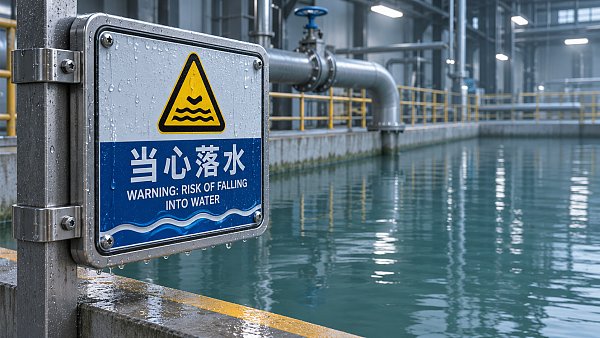
Consider an illuminated warning sign mounted beside a process-water tank. During commissioning it may be exposed only to washdown, but later changes in operating level could leave the lower cable entry submerged. The original IP67 claim may cover the sign enclosure as supplied, yet the installed system also depends on the gland, cable, connector, mounting penetrations and workmanship. A weak point outside the tested configuration can undermine the protection of the assembly.
For a non-illuminated sign, the failure mode may be different. There may be no electrical enclosure to protect, but the substrate can swell, printed layers can separate, adhesive can lose strength, and the message can become unreadable beneath deposits. An IP rating attached to a sign assembly does not by itself verify the long-term legibility or adhesion of its graphics.
This is where the duty description earns its place in a specification. “Waterproof” is too imprecise. Define whether the sign will be splashed, periodically flooded, submerged during shutdowns or continuously installed below the liquid level. Include the maximum expected depth, duration and range of operating temperatures, as well as any credible abnormal condition.
Is IP68 enough for a permanently submerged sign?
IP68 is the more relevant ingress-protection classification to investigate for continuous immersion, but the two digits still do not tell the whole story. Under IEC 60529, the conditions for IPX8 are subject to agreement between the manufacturer and the user, and must be more severe than those for IPX7. The marking alone does not state the permitted depth, duration or other agreed conditions.
Ask for the actual immersion limits and the basis on which they were established. An IP68 enclosure assessed for one depth and duration should not automatically be accepted for a deeper installation or an indefinite service period. Where a supplier uses phrases such as “continuous immersion,” the documentation should make clear what that means for the proposed application and whether it applies to the complete sign, including its cable entries and connectors.
Also check whether the duty includes water jets. The IPX7 and IPX8 immersion classifications do not automatically establish protection against every lower-numbered water test, including water jets. A sign that must tolerate both immersion and high-pressure cleaning may need evidence for both exposures, stated through the applicable ratings or test results.
In some installations, changing the mounting position is more defensible than specifying a more elaborate enclosure. If a warning must be visible to personnel above a tank, placing it above the credible flood level may reduce exposure without compromising its purpose. That decision still needs a visibility and site-safety review; moving a sign out of the water is no improvement if it can no longer be read where the hazard is encountered.
The liquid and the site can matter as much as the depth
An IP water-ingress test should not be treated as a blanket qualification for process liquids. Water in a mineral processing plant may contain suspended solids, dissolved salts, treatment chemicals or hydrocarbons. In a mine sump, abrasive material can accumulate around seals and fasteners. In coastal or saline environments, corrosion compatibility deserves particular attention.
The practical question is not simply whether the enclosure resists water today. It is whether its materials, seals, fasteners, labels and cable components remain suitable for the actual liquid and cleaning chemicals over the intended inspection interval. Obtain compatibility information for the specific materials and concentrations where available; generic claims such as “chemical resistant” leave too much room for interpretation.
Mechanical exposure is separate again. A sign mounted near bulk material handling equipment may be struck by tools, hoses or material. A casing that meets an ingress rating is not automatically impact-rated, and damage to a cover or gland can invalidate the protection expected from the original assembly. Specify mechanical protection or a less exposed mounting position when the location makes contact foreseeable.
For electrically powered signage, evaluate electrical safety, isolation and maintenance access alongside ingress protection. Hazardous-area requirements may also apply in some locations, but IP67 or IP68 alone does not establish suitability for an explosive atmosphere. The relevant site classification, equipment approvals and local requirements must be checked separately.
What to request before accepting a rating
The most useful supplier response ties a claim to a defined item and a defined configuration. Ask for documentation identifying the model or assembly assessed, the applicable standard and edition, and the rating claimed. Where independent certification is specified, verify the issuing body and scope rather than assuming that every test report represents third-party certification.
For a submerged installation, the review should resolve the following points:
- Immersion conditions: the permitted depth, duration, temperature and liquid, including whether the claim covers normal and abnormal operating levels.
- Assembly boundary: whether the assessment includes the installed lens, enclosure joints, glands, connectors, cable and any mounting penetrations.
- Installation constraints: approved orientation, cable routing, tightening requirements and restrictions on drilling or modifying the enclosure.
- Post-maintenance condition: whether seals are reusable, what must be replaced after opening, and how the enclosure is checked before returning to service.
- Visibility and durability: evidence appropriate to the project for graphics, adhesion, corrosion resistance and readability in the expected environment.
A representative test report can help, but evaluators should check whether the supplied sign uses the same materials and sealing arrangement as the tested sample. A substitution of gland, adhesive, gasket or cable may be commercially minor and technically significant. If the proposed installation differs from the tested arrangement, seek written confirmation or require an appropriate assessment of the changed configuration.
Site acceptance should also cover what can actually be inspected after installation. For example, a watertight enclosure is of limited use if a warning face is hidden by scale, mud or a raised liquid level. Define who checks the sign, how often the condition is reviewed under the site’s maintenance system, and what triggers replacement. Those intervals depend on the hazard and environment; the IP code does not set them.
Make the decision against the real duty
For temporary flooding within the stated test conditions, IP67 may be a reasonable part of the specification, provided the complete installed assembly and other environmental risks are addressed. For permanent submersion, do not infer suitability from IP67. Require a documented immersion duty for the actual depth and duration, verify compatibility with the liquid and installation, and assess whether the sign will remain functional and legible.
The best next step is often to put the proposed mounting drawing beside the supplier’s test scope. If the waterline, cable entry or maintenance arrangement on that drawing is not covered by the evidence, resolve the gap before purchase rather than after the sign is underwater.
Recommended News
 Nov 23, 2026How to verify a PPE supplier's product certificationsVerify a PPE supplier’s certifications with confidence. Learn to check product scope, issuer records and market requirements before you buy.
 Nov 19, 2026Can IP67 waterproof signage withstand permanent submersion?Can IP67 waterproof signage withstand permanent submersion? Discover its immersion limits and what to check before specifying signs for demanding industrial sites.
 Nov 16, 2026How to find reliable health resources for mining workersFind reliable health resources for mining workers. Learn how to assess sources, understand workplace hazards, and get qualified support.
 Nov 12, 2026Can a helium shortage disrupt MRI scans?Discover the impact of helium shortage on MRI services, from potential scan delays to rising costs, and learn how hospitals can prepare.