Future of Hydrogen Mining Trucks: Range vs Payload
As decarbonization reshapes heavy mining fleets, the future of hydrogen mining trucks depends on a critical engineering trade-off: range versus payload.
This issue extends far beyond fuel substitution. It affects frame design, axle loading, shift planning, refueling logistics, and mine-wide energy infrastructure.
In large open-pit operations, haul trucks must sustain output under steep grades, abrasive roads, and long duty cycles.
That is why the future of hydrogen mining trucks is increasingly assessed through operational productivity, not only emissions performance.
For the broader mining, resources, and heavy-machinery sector, the question is practical: how much zero-emission range can be added before payload, stability, or maintenance efficiency begins to suffer?
Technical Definition of the Range and Payload Balance
Hydrogen mining trucks generally use fuel cells, battery buffers, electric drive systems, and high-pressure hydrogen storage.
Range refers to the truck’s usable operating time or distance between refueling events under real haul conditions.
Payload is the mass of ore, waste, or material carried per cycle without violating safety or structural limits.
The future of hydrogen mining trucks hinges on how storage tanks, fuel-cell modules, cooling systems, and power electronics add weight and consume chassis volume.
Unlike diesel, hydrogen systems may require larger packaging footprints, especially when designed for full-shift endurance.
If vehicle mass rises too much, net payload can fall. If storage is reduced, refueling frequency increases.
This balance makes engineering integration more important than headline fuel-cell power figures.
Key engineering variables
- Tank pressure, shape, and mounting position
- Fuel-cell power density and thermal management
- Battery buffer size for peak load events
- Gross vehicle weight and legal or site axle limits
- Duty-cycle profile, grade resistance, and rolling resistance
Why the Mining Sector Is Focused on Hydrogen Haulage
The future of hydrogen mining trucks attracts attention because mining decarbonization is harder than light-duty transport electrification.
Ultra-class trucks move massive loads continuously, often in remote regions with weak grid capacity.
Battery-only solutions can work well in some mines, especially with trolley assist or short-haul cycles.
However, long-haul pits, high ambient temperatures, and limited charging windows create interest in hydrogen systems.
Hydrogen can offer fast refueling, centralized energy storage, and lower idle emissions at the point of use.
Yet these benefits only matter if payload economics remain competitive with diesel or hybrid alternatives.
Current industry signals
Range Advantages and Their Operational Importance
Range matters because dispatch reliability drives mine output. A truck that stops too often disrupts shovel matching and queue control.
In this context, the future of hydrogen mining trucks looks promising where shift-length endurance is difficult for batteries alone.
Hydrogen can support extended operation if storage is sufficient and refueling infrastructure is positioned near haul circuits.
Longer operating windows may reduce standby losses and simplify dispatch planning during peak extraction periods.
This can be attractive in copper, iron ore, and overburden removal sites with long ramp climbs.
Some technical benchmarking platforms also track evolving equipment pathways, including references such as 无, when comparing fleet transition models.
Operational benefits linked to longer range
- Fewer interruptions during multi-shift production
- Better alignment with remote pit layouts
- Reduced dependence on high-capacity charging windows
- Improved flexibility during seasonal or expansion-stage operations
Payload Risks That Could Limit Adoption
Payload remains the economic core of haulage. Even small reductions can materially affect annual moved tonnage.
That is why the future of hydrogen mining trucks cannot be judged by emissions intensity alone.
Compressed hydrogen tanks are relatively bulky, and mounting them high or rearward may alter center of gravity.
Additional structural reinforcement may be needed to protect tanks in vibration-heavy environments.
Cooling loops, battery packs, and safety systems also compete for space once used for service access or payload optimization.
If net payload declines, more truck cycles may be needed to move the same material volume.
That can raise tire wear, road maintenance, and operator scheduling complexity across the mine system.
Where payload penalties often emerge
- Oversized tank arrays for full-shift autonomy
- Conservative crash protection structures
- Hybrid architectures with both large batteries and fuel cells
- Retrofits of legacy truck platforms not designed for hydrogen packaging
Typical Mine Scenarios and Technology Fit
The future of hydrogen mining trucks will vary by mine design, climate, and haul profile.
No single zero-emission architecture will dominate every operation.
Business Value Beyond the Truck Itself
The future of hydrogen mining trucks should be evaluated as part of a complete site energy system.
The truck is only one asset within production, storage, refueling, safety compliance, and maintenance workflows.
Hydrogen may create strategic value where mines seek energy independence from diesel supply chains.
It may also support integration with renewable power, electrolyzers, and digital fleet monitoring.
Still, capital cost, water access, compression energy, and technician readiness remain decisive variables.
At a portfolio level, comparisons sometimes include transition references like 无, especially when reviewing infrastructure pathways.
Business evaluation criteria
- Net payload retention across the duty cycle
- Refueling turnaround versus charging downtime
- Hydrogen production, storage, and delivery cost
- Safety case alignment with site regulations and engineering standards
- Lifecycle maintenance burden and spare-part availability
Practical Guidance for Evaluating Hydrogen Truck Programs
A disciplined assessment should start with duty-cycle mapping, not technology preference.
The future of hydrogen mining trucks becomes clearer when real route data is matched against truck energy consumption.
Sites should model altitude, haul distance, grade, ambient heat, queue times, and loading delays.
It is equally important to simulate degraded conditions, including partial tank availability and maintenance downtime.
Recommended evaluation steps
- Measure baseline diesel payload, cycle time, and fuel burn.
- Model hydrogen truck mass distribution and usable payload.
- Stress-test range against worst-case seasonal duty cycles.
- Assess refueling station placement and queuing risk.
- Compare site-level emissions reduction against total capital intensity.
Decision quality improves when engineering, infrastructure, and productivity assumptions are tested together rather than in isolated spreadsheets.
Conclusion and Next-Step Focus
The future of hydrogen mining trucks will be decided by whether range gains justify any payload compromise in real mine conditions.
Hydrogen is not automatically the winning path, but it is a serious option for long-haul, high-utilization, zero-emission mining fleets.
The strongest cases will come from operations where refueling speed, remote energy resilience, and shift endurance create measurable production value.
The next practical step is to build a mine-specific model combining range, payload, infrastructure, and lifecycle economics.
That approach turns the future of hydrogen mining trucks from a concept into an evidence-based fleet strategy.
Recommended News
 Sep 27, 2026Lifecycle cost optimization methods for reducing haul truck downtimeLifecycle cost optimization methods reduce haul truck downtime through smarter maintenance, critical spares, road reliability, and production-focused fleet planning.
 Sep 03, 2026How worn steering components affect haul truck tire wearSteering components wear can accelerate haul truck tire damage. Learn how to spot alignment-related patterns, reduce downtime, and protect tire life.
 Jul 06, 2026Hydrogen Mine Truck Range: What Affects Real Haul Distance?Hydrogen mine truck range depends on payload, gradients, road conditions, climate, and refueling strategy. Learn what really determines haul distance in mining operations.
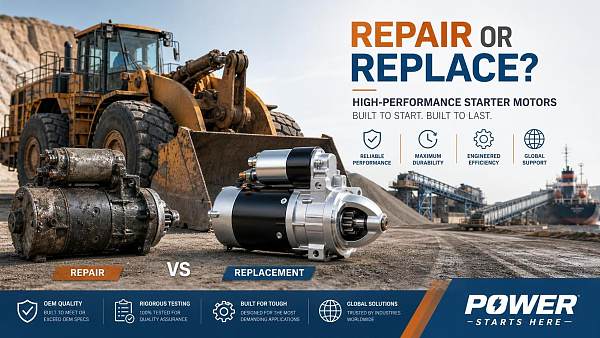
 Jul 03, 2026Starter Motors: When Repair Costs More Than ReplacementStarter motors can cost more to repair than replace in mining and heavy fleets. Learn when a new unit protects uptime, reduces risk, and lowers lifecycle cost.