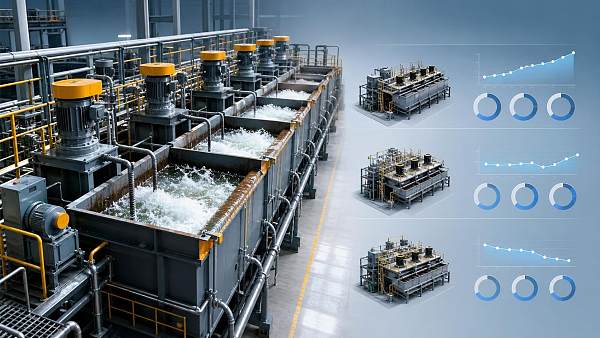
Metallurgy Equipment Upgrades That Pay Back Slower Than Expected
Not every metallurgy equipment upgrade delivers returns on the timeline promised in vendor models. For researchers and operators navigating industrial mining equipment decisions, this article examines why payback can lag due to mining industry standards, mining equipment reliability, commissioning risk, and shifting mining commodities markets—while showing how mining benchmarking and digital twins mining can improve capital planning across the modern mining fleet.
In mineral processing and metallurgy, upgrade decisions are rarely judged by nameplate capacity alone. A thickerener retrofit, furnace control modernization, mill relining system, filtration upgrade, or waste-heat recovery package may look compelling in a spreadsheet, yet actual payback often slips from 18 months to 30 months, or from 3 years to 5 years. The gap is usually not caused by one major failure, but by a stack of smaller operational realities.
For procurement analysts, maintenance planners, plant managers, and equipment operators, the practical question is not whether modernization is valuable. It is how to identify which metallurgy equipment upgrades are likely to pay back slower than expected, why that happens, and what data should be gathered before capital is committed. That is where structured benchmarking, lifecycle cost analysis, and realistic commissioning assumptions become more useful than optimistic vendor ROI models.
Why Metallurgy Equipment Payback Models Often Miss Real Plant Conditions
Most payback models begin with a clean baseline: stable ore feed, predictable uptime, standard maintenance intervals, and uninterrupted utility supply. In a real concentrator, smelter, or hydrometallurgical plant, these assumptions are often wrong by 10%–25%. Even a small deviation in feed moisture, grind size, refractory wear, or reagent consumption can materially change the savings profile of an equipment upgrade.
A second issue is that many upgrade proposals focus on one performance variable while underestimating system dependency. For example, a more efficient furnace burner or high-capacity filter may improve one section, but the upstream crushing circuit, slurry transfer pumps, or tailings handling line may become the constraint. When bottlenecks move instead of disappearing, projected annual throughput gains are delayed.
Researchers comparing industrial mining equipment options should also note the difference between technical performance and commercial payback. A unit may achieve a 6% reduction in specific energy use, but if the site processes lower-grade ore for two quarters, or commodity prices decline by 15%, the financial return schedule changes even though the machine is performing correctly.
Operators see another practical issue: learning curves. A new thickener control package, flotation air system, or digital process control interface may need 8–16 weeks before crews use it consistently. During that period, alarm fatigue, manual overrides, and conservative operating settings reduce the gains expected during vendor acceptance testing.
Common assumptions that distort ROI forecasts
- Assuming 90%+ availability immediately after handover, when actual stabilized availability may be closer to 75%–85% in the first quarter.
- Using ideal ore characteristics instead of seasonal or blended feed variability across 3–4 operating campaigns.
- Ignoring downtime for refractory cure, alignment checks, instrumentation recalibration, and operator retraining.
- Counting energy savings without pricing in higher spare-parts cost, software licensing, or specialist contractor support.
Where benchmarking improves forecast accuracy
A benchmark-based capital review compares the proposed upgrade not only against the supplier’s reference case, but also against plants with similar duty cycles, feed chemistry, maintenance maturity, and environmental constraints. This matters because two assets with the same rated capacity can produce very different outcomes under ISO-aligned operating and maintenance regimes.
The table below shows how forecast error usually comes from combinations of technical, operational, and market variables rather than a single bad assumption.
The key takeaway is simple: metallurgy equipment upgrades should be modeled as system interventions, not standalone hardware purchases. Sites that anchor forecasts to realistic ramp-up periods, variable feed conditions, and maintenance capacity generally produce better capital decisions and fewer post-installation surprises.
The Upgrade Types Most Likely to Pay Back Slower Than Expected
Not all metallurgy upgrades carry the same payback risk. Projects that depend on complex process integration, extensive automation, or narrow ore-characteristic assumptions tend to underperform financially during the first 12–24 months. This does not mean they are poor investments. It means their business cases need wider tolerance bands and stronger commissioning plans.
Energy-efficiency retrofits are a good example. Waste-heat recovery systems, variable speed drives, and advanced burner controls often show attractive specific savings on paper. Yet if the plant runs below design throughput for several months, or utility tariffs change less than expected, the annual benefit is diluted. In some operations, the technical payback remains valid while the accounting payback slips by 1–2 budget cycles.
Automation and digital control upgrades also deserve scrutiny. They can improve stability, reduce operator variability, and support predictive maintenance, but their full value often depends on instrument reliability, historian data quality, and disciplined change management. A plant can install advanced controls in 3 months, then need another 6 months to clean sensor drift issues and retune loops.
High-wear process equipment upgrades, such as improved lining systems, pressure filtration units, and refractory packages, may also pay back more slowly if the maintenance team lacks stocking discipline or if wear mechanisms differ from those assumed during the proposal stage. A lining material designed for one abrasive profile may not deliver the same life extension under higher silica or variable pH conditions.
Upgrade categories with elevated delay risk
The matrix below helps procurement and operations teams identify which upgrade categories require the most conservative ROI treatment.
This comparison does not argue against upgrades. It shows where project teams should add contingency, pilot testing, or phased implementation. In many cases, the difference between an acceptable 24-month payback and a disappointing 42-month payback is not equipment quality, but pre-upgrade due diligence.
A practical screening rule
- If an upgrade depends on more than 3 upstream process variables, widen the payback range rather than using a single-point estimate.
- If more than 20% of savings depend on behavior change, include training, supervision, and KPI follow-up as capital-adjacent costs.
- If the project must survive 2 different ore campaigns to prove value, avoid claiming full ROI in the first operating quarter.
Commissioning Risk, Reliability Gaps, and Standards Compliance
In mining and metallurgical operations, the period between mechanical completion and stable production is where many payback models fail. Commissioning is not a single milestone. It is a controlled transition through checks, startup, tuning, acceptance, and early-life support. Depending on process complexity, this phase may last 30 days or more than 180 days.
Mining industry standards and site compliance requirements can extend this window. Alignment with ISO procedures, local electrical codes, pressure-system inspection rules, environmental permit conditions, and mine safety acts often requires staged verification. The equipment may be installed on time, but formal sign-off can wait until alarm logic, interlocks, emissions behavior, or guarding meet site standards.
Reliability is another source of delay. A retrofit that introduces new sensors, drives, or control cabinets may improve long-term performance while creating short-term reliability noise. Failures during the first 500–1,000 operating hours are not unusual, especially when cable routing, heat load, dust exclusion, or lubrication practices are not fully aligned with the original engineering assumptions.
Operators often notice this before managers do. Nuisance trips, unstable readings, and access constraints during maintenance can add minutes to every shift. Those minutes compound into lower availability, more bypass operation, and delayed optimization. The result is not catastrophic failure, but a softer productivity curve that pushes the payback date outward.
Four commissioning checkpoints that protect ROI
- Pre-start verification: confirm instrument calibration, interlock logic, alignment tolerances, lubrication readiness, and spare critical components before energization.
- Staged performance testing: measure performance at 50%, 75%, and 100% design load rather than relying on one short acceptance run.
- Early-life reliability tracking: log failures, alarms, and manual interventions over the first 8–12 weeks to identify hidden constraints.
- Operator competency checks: validate startup, shutdown, override, and emergency response tasks across all crews, not just one day shift team.
Reliability questions researchers should ask
When comparing industrial mining equipment, researchers should request failure mode visibility, not just rated efficiency. Useful questions include mean time between maintenance interventions, recommended inspection interval, critical spare lead time, and the expected failure profile during the first year. A drive system with a 16-week replacement lead time can materially increase working capital exposure, even if its efficiency benefit is attractive.
It is also important to separate process availability from mechanical availability. A unit can be mechanically available 95% of the time but still depress plant output if control instability, feed mismatch, or utility limitations force conservative operation. This distinction is essential when reviewing suppliers’ reference data.
Minimum documentation set before approval
- Commissioning plan with weekly milestones for at least the first 12 weeks.
- Site-specific reliability assumptions, including dust, temperature, vibration, and operator staffing conditions.
- Standards compliance matrix listing applicable ISO, AS/NZS, electrical, guarding, and environmental obligations.
- Critical spare-parts list with lead times, stocking recommendations, and first-year consumption assumptions.
Plants that force these details into the approval process usually make more disciplined decisions. They may reject some upgrades, phase others, and renegotiate performance guarantees. But they also reduce the number of projects that look good in year-zero presentations and weak in year-one operations.
How Commodity Cycles and Throughput Variability Change Upgrade Economics
Metallurgy equipment does not pay back in a market vacuum. The same upgrade can look outstanding during a strong copper, gold, nickel, or iron ore cycle and disappointing during a weaker pricing period. For this reason, financial models should test at least 3 scenarios: base case, downside case, and throughput-constrained case.
Commodity price volatility matters because many upgrades are justified partly by incremental metal recovery or increased throughput. If metal prices fall by 12% while ore grades drift lower, the value of each additional recovered ton changes immediately. The project may still be operationally sound, but the financial payback slows without any defect in the equipment itself.
Throughput variability also reshapes economics. A filtration upgrade justified at 8,000 operating hours per year will not generate the same annual benefit if water constraints, blasting delays, or maintenance backlogs reduce actual plant run time to 6,500 hours. This is common in integrated mining fleets where mine performance, haulage availability, crusher uptime, and metallurgy stability are tightly linked.
For users and operators, the lesson is straightforward: equipment ROI is not just a metallurgical question. It is a mine-to-mill question. If the whole mining fleet cannot sustain the feed profile assumed in the business case, the metallurgy upgrade inherits the instability.
Decision factors that should be stress-tested
The following framework helps teams test whether an upgrade remains sensible across changing market and production conditions.
This type of scenario planning is especially important for institutions following global tenders and commodity-linked investment cycles. It allows decision-makers to separate upgrades that remain robust across market swings from those that only look attractive in peak conditions.
A useful capital planning principle
If a project only meets hurdle rates under one narrow throughput and pricing assumption, it should be classified as high-sensitivity capital. Such projects may still proceed, but they should compete for funding against lower-sensitivity upgrades such as debottlenecking in maintenance access, spare redundancy, or utility reliability, which often produce steadier returns.
Using Benchmarking and Digital Twins Mining to Improve Upgrade Decisions
Mining benchmarking is valuable because it moves the discussion from vendor promise to comparative evidence. By evaluating equipment performance against similar plants, duty cycles, standards environments, and maintenance strategies, teams can identify whether a forecast is realistic, aggressive, or incomplete. This is especially useful when reviewing high-value metallurgy retrofits across multiple global regions.
Digital twins mining adds another layer. A properly configured digital twin does not just display process values. It can simulate how an upgrade behaves under variable ore hardness, moisture, thermal load, equipment health, and operating practices. Instead of asking whether a filter, furnace, thickener, or automation package works at design point, teams can ask how it performs across 12 months of likely plant conditions.
For operators, the practical benefit is visibility. A digital twin can highlight where gains are lost: excessive recirculating load, unstable feed density, delayed valve response, poor shift change discipline, or incorrect setpoint management. For researchers and procurement specialists, it creates a structured basis for comparing alternatives beyond brochure data.
This is where institutions like G-MRH create value. A benchmarking repository aligned with international engineering standards and lifecycle cost logic can help buyers test assumptions across open-pit, underground, processing, metallurgy, material handling, and green mining transitions. That broader industrial context matters because metallurgical payback is often linked to fleet reliability, tender timing, power costs, and ESG-driven operating constraints.
What a stronger evaluation workflow looks like
- Establish a 12-month baseline for throughput, availability, maintenance cost, energy intensity, and operator interventions.
- Compare the target upgrade against at least 3 reference plants or benchmark datasets with similar feed and duty conditions.
- Run scenario tests in a digital twin or process model using seasonal, ore-blend, and downtime variability.
- Define acceptance criteria for 30, 90, and 180 days rather than only final nameplate performance.
- Review payback with downside assumptions before release of purchase order or EPC package.
Questions to ask before committing capital
For information researchers
Has the equipment been benchmarked under similar ore conditions, ambient temperatures, and maintenance maturity? Are claimed savings based on site data, pilot data, or generic reference cases? Does the supplier distinguish between technical success and commercial payback under variable commodity conditions?
For operators and end users
Will the upgrade simplify daily work or add complexity? Can crews maintain it with existing tools and skills? Are alarms, access points, cleanout tasks, and spare changeouts practical during live operations? If these questions are ignored, even an efficient upgrade can underdeliver financially.
FAQ for Procurement Teams and Plant Operators
How long should a realistic metallurgy equipment payback review take?
For a moderate retrofit, a serious review often takes 4–8 weeks, including baseline validation, maintenance input, supplier clarification, and risk scoring. For larger projects tied to plant shutdowns or EPC integration, 8–16 weeks is more realistic. Fast approvals usually increase the chance that commissioning, spares, and training costs are underestimated.
Which KPI matters more: energy savings or availability?
In many metallurgical plants, availability is the stronger payback lever. A 2%–4% increase in stable operating time can be more valuable than a similar percentage drop in energy intensity, especially where fixed costs are high and throughput is constrained. The right answer depends on the circuit, but both should be reviewed together rather than separately.
What is the most common mistake in upgrade procurement?
The most common mistake is buying a technically strong component without validating system readiness. This includes poor instrumentation quality, lack of spare inventory, no operator training budget, weak utility support, or unrealistic shutdown schedules. In practice, the surrounding system determines whether the equipment’s promised value can actually be captured.
When should digital twins mining be used instead of a simple spreadsheet model?
A spreadsheet is often sufficient for low-complexity replacements with clear maintenance savings. A digital twin or dynamic process model becomes more useful when 3 or more interacting variables drive value, such as ore variability, energy load, control response, and fleet-linked throughput. The more interconnected the upgrade, the more valuable simulation becomes.
Metallurgy equipment upgrades can still be highly profitable, but only when payback is judged against real operating conditions rather than idealized sales assumptions. Commissioning risk, standards compliance, mining equipment reliability, throughput variability, and commodity price movement all influence whether a project returns in 18 months, 36 months, or longer.
For organizations evaluating capital across mineral processing, metallurgy, and the wider mining fleet, the strongest decisions combine benchmarking, lifecycle cost discipline, and scenario-based planning. G-MRH supports that process by helping buyers, analysts, and operators compare equipment through a wider lens of engineering performance, compliance, and market context.
If you are reviewing metallurgy upgrades, planning a retrofit, or testing competing industrial mining equipment options, now is the time to build a more realistic decision framework. Contact us to discuss benchmarking inputs, evaluate upgrade risk, and get a tailored solution for more dependable capital planning.
Recommended News
 Sep 23, 2026What drives reagent consumption per ton price trends in flotation?Reagent consumption per ton price trend explained: uncover how ore variability, dosage, logistics, and plant performance shape flotation costs and smarter purchasing decisions.
 Aug 17, 2026Do surfactants improve flotation recovery in fine ores?Surfactants can improve fine-ore flotation recovery when matched to ore type, water chemistry, and reagents. Learn when they boost recovery without sacrificing grade or control.
 Aug 04, 2026Flotation Machine Wholesale: How to Compare Cell Size, Recovery Rate, and Total CostFlotation machine wholesale buying guide: compare cell size, recovery claims, energy use, wear parts, and total cost to choose the right package and avoid expensive procurement mistakes.
 Jun 16, 2026Flotation Machines: Key Performance Factors for Better Recovery RatesFlotationmachines performance depends on air dispersion, froth control, reagent response, and stability. Learn how to compare designs and improve recovery rates with practical insights.