Solar Street Lights: Cost, Lifespan, and Off-Grid Planning
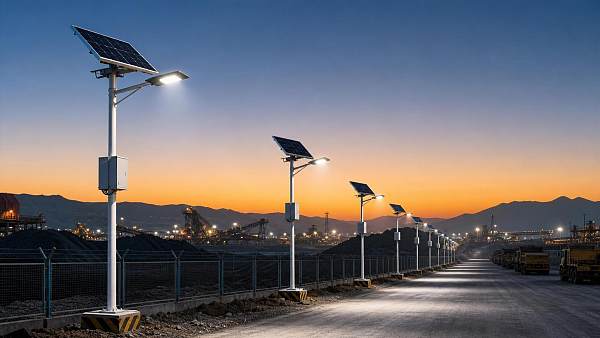
Solar street lights are no longer a niche option for remote roads. In mining corridors, temporary works, logistics yards, and perimeter zones, they often solve a very practical problem.
The appeal is simple. You avoid trenching, reduce dependency on unstable grids, and speed up deployment where infrastructure schedules are tight.
Still, the buying decision is rarely about a headline price. Cost, lifespan, battery design, lighting autonomy, and site conditions all shape real project value.
In heavy-industry environments, that judgment matters even more. G-MRH frequently highlights the same pattern across equipment categories: low upfront cost can become expensive when lifecycle reliability is ignored.
That is why solar street lights should be reviewed like any other engineered asset. The right question is not only what they cost today, but how they perform over years of duty.
Are solar street lights really cost-effective, or just cheaper to install?
This is usually the first concern, and it should be. Solar street lights can cost more per unit than conventional fixtures, especially when larger batteries and stronger poles are required.
However, installed cost often tells a different story. If a site needs trenching, cabling, switchboards, permits, and utility coordination, grid-connected lighting can become significantly more expensive.
In remote access roads or temporary project zones, solar street lights can cut civil work sharply. That changes the financial comparison from fixture price to total delivered lighting cost.
A realistic cost review should include the following:
- Pole, luminaire, battery, controller, and solar panel specification.
- Foundation requirements and wind-load design.
- Transport, lifting, and installation labor.
- Battery replacement cycle over the project life.
- Cleaning, inspection, and spare-part planning.
In practice, solar street lights are most cost-effective where grid extension is difficult, diesel generation is undesirable, or construction windows are short.
Where reliable utility power already exists beside the road, the savings case becomes less obvious. In those locations, maintenance strategy and energy cost assumptions decide the outcome.
What should you expect the lifespan of solar street lights to be?
The short answer is that different components age at different speeds. Treating the whole system as one lifespan number can lead to poor planning.
LED modules often last 50,000 to 100,000 hours, depending on thermal management and drive current. Poles may last 15 to 25 years if corrosion protection matches the site.
The battery is usually the decisive component. Lithium batteries commonly deliver five to eight years, while lower-grade systems may underperform much earlier in hot climates.
Solar panels generally retain useful output for well over a decade, but dust, shading, and physical damage can reduce real energy yield long before end-of-life.
A simple planning table makes the replacement logic clearer:
In harsh industrial regions, the best indicator is not a brochure claim. It is whether the design aligns with climate data, maintenance access, and realistic operating hours.
How do you plan an off-grid solar street light system without under-sizing it?
This is where many projects go wrong. A solar street light system is not sized by pole spacing alone.
The first step is defining the lighting task. A haul-road intersection, camp roadway, storage yard edge, and pedestrian path do not need the same lux level or operating profile.
Then the energy side must be checked. Battery capacity and panel size should match local solar irradiation, seasonal cloud cover, and required autonomy days.
A common mistake is using average sunshine data only. For off-grid planning, the more useful figure is worst-month solar availability.
For a reliable layout, confirm these inputs before comparing models:
- Required illumination level and uniformity target.
- Nightly operating hours and dimming schedule.
- Autonomy requirement, such as two to five nights.
- Ambient temperature range and dust severity.
- Pole height, spacing, and wind loading.
- Future relocation or phased expansion needs.
In mining, resources, and heavy-construction settings, modularity can be valuable. Temporary roads and contractor compounds often benefit from systems that can be moved as site layouts change.
That said, portable thinking should not weaken structural design. Off-grid does not mean light-duty, especially in high-wind or high-vibration zones.
Which specification details matter more than the headline wattage?
Wattage is easy to compare, but it is a poor shortcut. Two solar street lights with the same nominal wattage can perform very differently on the road.
Optics are often more important than raw power. A well-designed lens can place light exactly where vehicles and pedestrians need it, reducing wasted output.
Battery chemistry and controller logic also deserve close attention. Smart dimming, motion response, and battery protection routines can extend service life and improve autonomy.
When comparing solar street lights, these checkpoints are usually more useful than a basic datasheet headline:
- Delivered lumens and optical distribution pattern.
- Battery type, usable capacity, and replacement access.
- Controller settings for dimming and low-voltage protection.
- Ingress protection and corrosion resistance.
- Structural certification for pole, bracket, and panel mount.
- Compliance with ISO-related quality processes or regional standards.
This is also where a benchmarking mindset helps. G-MRH often frames equipment selection around duty-cycle reality rather than catalog equivalence, and the same discipline applies here.
If a specification cannot explain performance during low-sun periods, dust accumulation, or battery replacement intervals, it is incomplete for serious planning.
What risks are most often missed during procurement?
The biggest risk is buying solar street lights as commodity items when the site conditions are highly specific. Low-price offers often hide weak battery reserves or unrealistic runtime assumptions.
Another missed issue is maintenance access. An integrated all-in-one unit may look neat, but service complexity rises if battery replacement requires special tools or full-unit removal.
There is also a planning risk around environmental exposure. Dust, salt, humidity, and high ambient heat can shorten component life unless enclosure quality and coatings are matched to the site.
Before approval, it helps to run a quick decision check:
A final point is supply continuity. For projects with long operating lives, spare batteries, drivers, and mounting parts should be considered early, not after failures start.
When do solar street lights make the strongest business case?
They make the strongest case where civil power is costly, uncertain, or slow to deploy. This includes mine approach roads, temporary project camps, stockyard boundaries, and infrastructure expansion zones.
They are also attractive where ESG reporting and decarbonization targets matter. Avoiding diesel-powered lighting towers for long-duration use can improve both emissions performance and operating logistics.
That does not mean every site should default to solar street lights. If shading is severe, nighttime demand is very high, or maintenance access is poor, hybrid or grid-tied alternatives may be more resilient.
A sensible next step is to build a short decision file. List lighting classes, required autonomy, climate risks, replacement assumptions, and total installed cost for each option.
From there, compare solar street lights on lifecycle logic rather than unit price alone. That usually leads to a more durable result, especially in heavy-duty and off-grid environments.
If uncertainty remains, validate one representative zone first. A pilot layout can reveal real battery behavior, cleaning needs, and nighttime performance before wider deployment.
Recommended News
 Sep 16, 2026What to verify before choosing a mobile concrete pump supplierMobile concrete pump supplier selection made simple: verify performance, safety, parts availability, service support, and lifecycle cost before you invest.
 Aug 20, 2026When does a cold milling machine OEM make sense over a generic supplier?Cold milling machine OEM or generic supplier? Learn when OEM support, parts traceability, uptime, and lifecycle value justify the higher cost.
 Aug 06, 2026How to Evaluate an Asphalt Paver Wholesale Supplier for Parts Support and Lead TimesAsphalt paver wholesale supplier evaluation starts with parts support and lead times. Learn how to compare inventory, technical service, and downtime risk before you buy.
 Jun 24, 2026Solar Street Lights: Cost, Lifespan, and Off-Grid PlanningSolar street lights guide: compare real cost, lifespan, battery replacement, and off-grid planning to choose reliable lighting for industrial and remote sites.