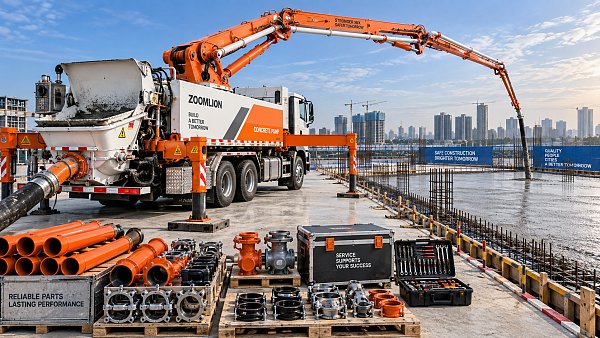
Concrete Pump Supplier: What Affects Lifetime Cost
Choosing a concrete pump supplier is not just about the purchase price. For procurement teams in mining, construction, and heavy-industry projects, lifetime cost depends on equipment reliability, spare-parts availability, energy efficiency, maintenance intervals, and after-sales support. This guide explains the key cost drivers that shape long-term value and helps buyers make more informed, lower-risk sourcing decisions.
Why lifetime cost matters more than initial price
A concrete pump supplier influences far more than the invoice value of a machine. In remote mining zones, large infrastructure packages, and EPC-driven projects, the true cost emerges over years of operation.
Procurement teams often face pressure to reduce capex quickly. Yet a lower-priced pump can create higher downtime, slower parts replenishment, more fuel consumption, and repeated wear-component replacement.
For buyers responsible for project continuity, the question is practical: which concrete pump supplier can support stable output under abrasive materials, long duty cycles, and variable site conditions?
- Frequent stoppages can delay concrete placement windows and increase labor standby cost.
- Weak regional service coverage can extend repair lead times when hydraulic or electrical faults occur.
- Inconsistent component quality can shorten wear life in pipelines, S-valves, pistons, and delivery cylinders.
- Poor documentation can complicate compliance, operator training, and maintenance planning.
What procurement teams should evaluate in a concrete pump supplier
The most effective sourcing reviews combine technical fitness, commercial risk, and operational support. In heavy-industry environments, a concrete pump supplier should be assessed as a lifecycle partner rather than a one-time vendor.
The table below summarizes core procurement dimensions that directly affect total ownership cost, especially where utilization rates are high and access to service is limited.
For procurement personnel, this matrix helps separate visible cost from hidden cost. It also supports cross-functional discussions between sourcing, operations, maintenance, and HSE teams.
Key questions to ask before shortlisting
- What material mix, line pressure, vertical reach, and hourly output will the pump face in actual field conditions?
- Can the concrete pump supplier provide a realistic maintenance plan based on abrasive duty rather than ideal laboratory assumptions?
- Are critical wear components stocked in the project region, or will every replacement depend on overseas shipment?
- What operator training and commissioning support are included in the commercial scope?
Which cost drivers most affect long-term ownership?
1. Reliability under real duty cycles
Concrete pumps in mining and heavy civil works rarely operate in gentle conditions. They handle long pumping distances, changing aggregate characteristics, temperature swings, and dust-heavy job sites.
A concrete pump supplier with stronger engineering discipline usually pays close attention to hydraulic cooling, component matching, wear resistance, and service access points. These details reduce failure frequency over time.
2. Wear-part consumption
Pistons, cutting rings, wear plates, pipes, bends, and seals are recurring expenses. If the pump is poorly matched to the mix design or pressure requirement, parts consumption can rise quickly.
Procurement should request expected replacement intervals under comparable duty conditions. Even broad ranges are useful if they are grounded in site reality.
3. Power and fuel demand
An oversized unit may appear safer, but it can increase energy cost if output demand is moderate. An undersized unit can also be expensive because it runs under strain and extends pumping time.
A capable concrete pump supplier should align engine or motor specification with expected throughput, line length, and pumping frequency.
4. Downtime response and field service
In major pours, lost hours can cost more than the replacement part itself. The supplier’s ability to diagnose quickly, dispatch support, and provide correct parts documentation often determines recovery speed.
Concrete pump supplier comparison: low-price offer versus lifecycle-value offer
Many buyers compare quotations line by line, but the smarter comparison is between sourcing models. The table below shows how different supplier profiles can alter project economics beyond the purchase order stage.
For strategic projects, the third model often creates lower total cost, especially when delays carry contractual penalties. This is where evidence-based benchmarking becomes valuable.
How application scenario changes the best supplier choice
Not every concrete pump supplier is equally suitable for every project. Procurement decisions should reflect the duty profile rather than rely on generic marketing claims.
Mining and remote resource sites
Remote operations need durability, field-repair practicality, and dependable spare-parts logistics. In these settings, a supplier with weak support coverage can create prolonged shutdowns and high freight premiums.
Urban infrastructure and large pours
Dense schedules and restricted working windows shift value toward output consistency, low setup disruption, and fast troubleshooting. Service response time becomes a major commercial factor.
EPC and multi-country deployment
Documentation quality, standardization, and training packages matter more when the same equipment family is used across regions. The supplier must support repeatability as well as supply continuity.
- Check whether operating manuals, maintenance schedules, and parts lists are complete and consistent.
- Review whether the supplier can support different power configurations and local regulatory requirements.
- Ask how commissioning quality is controlled across different sites and subcontractor teams.
What standards, compliance, and documentation should buyers request?
In the heavy-machinery supply chain, compliance risk is not limited to product safety. Buyers also need traceable technical documents, maintenance instructions, and clarity on operating limits.
G-MRH’s sector perspective is useful here because procurement teams increasingly evaluate suppliers against engineering standards, site safety expectations, and ESG-linked procurement frameworks.
These records do not guarantee performance on their own, but they reduce ambiguity. For procurement teams, less ambiguity usually means fewer disputes after delivery.
Common buying mistakes that increase lifetime cost
Choosing by maximum output alone
Headline output figures may not reflect actual line length, material slump, pipeline layout, or altitude. Overreliance on peak numbers can produce poor equipment matching.
Ignoring spare-parts strategy
A concrete pump supplier may quote attractively while offering limited local stock. If critical items must be imported each time, downtime cost can quickly exceed the initial savings.
Underestimating training needs
Improper startup, line cleaning, or pressure management can accelerate wear and trigger avoidable failures. Supplier-led training is often a cost-control tool, not just a handover formality.
Treating all suppliers as technically equivalent
In industrial procurement, differences in design quality, support depth, and documentation discipline are rarely visible from a basic quotation sheet. Structured comparison is essential.
How G-MRH supports better sourcing decisions
For procurement directors and engineering buyers, G-MRH adds value by connecting commercial decisions with technical benchmarking. That is especially important when evaluating a concrete pump supplier for large, risk-sensitive projects.
Our industry framework covers mining, earthmoving, construction, material handling, and digitalized heavy assets. This allows buyers to compare supplier claims against broader machinery performance logic rather than isolated sales promises.
- Benchmark equipment duty-cycle suitability for harsh and continuous operations.
- Review lifecycle cost drivers that are often hidden during early quotation stages.
- Align supplier evaluation with engineering standards, safety expectations, and ESG-sensitive procurement.
- Support buyers facing cross-border sourcing, tender analysis, and long-horizon asset planning.
FAQ: concrete pump supplier selection for procurement teams
How do I compare two concrete pump supplier quotes fairly?
Normalize the comparison around the same duty assumptions: hourly output, line distance, material characteristics, service interval, included spare parts, commissioning scope, and response commitments. A lower headline price is not comparable if exclusions shift cost to the buyer later.
Which parts most often affect ongoing cost?
Wear plates, cutting rings, pistons, delivery pipes, bends, seals, and some hydraulic components typically drive recurring spend. Their replacement frequency depends on pressure, aggregate abrasiveness, operator discipline, and pipeline design.
Is a local supplier always the better choice?
Not always. Local service strength is valuable, but technical mismatch can still create long-term losses. The best choice is often the supplier that balances fit-for-purpose engineering, documentation quality, and reliable regional support.
What delivery and support details should procurement confirm?
Confirm manufacturing lead time, shipping terms, commissioning scope, operator training, warranty boundaries, spare-parts package, and fault escalation contacts. These items affect startup risk as much as the machine specification itself.
Why choose us for concrete pump supplier evaluation and sourcing guidance
G-MRH helps procurement teams move beyond price-only selection. Our focus is to clarify lifetime cost, technical suitability, compliance expectations, and supplier support risk across heavy-industry applications.
If you are assessing a concrete pump supplier for mining, infrastructure, or heavy construction use, you can consult us on practical sourcing issues that directly affect project outcomes.
- Parameter confirmation for output, pressure, line distance, and material compatibility.
- Supplier comparison for lifecycle cost, service coverage, and parts strategy.
- Delivery-cycle review for urgent projects and phased equipment deployment.
- Support on documentation, standards alignment, and tender evaluation criteria.
- Discussion of customized sourcing pathways for remote operations or multi-country EPC programs.
When procurement decisions involve high utilization, tight schedules, or difficult site access, better benchmarking reduces expensive surprises. Contact us to review your specification, shortlist options, and build a sourcing decision around long-term value rather than initial price alone.
Recommended News
 Sep 16, 2026What to verify before choosing a mobile concrete pump supplierMobile concrete pump supplier selection made simple: verify performance, safety, parts availability, service support, and lifecycle cost before you invest.
 Aug 20, 2026When does a cold milling machine OEM make sense over a generic supplier?Cold milling machine OEM or generic supplier? Learn when OEM support, parts traceability, uptime, and lifecycle value justify the higher cost.
 Aug 06, 2026How to Evaluate an Asphalt Paver Wholesale Supplier for Parts Support and Lead TimesAsphalt paver wholesale supplier evaluation starts with parts support and lead times. Learn how to compare inventory, technical service, and downtime risk before you buy.
 Jun 24, 2026Solar Street Lights: Cost, Lifespan, and Off-Grid PlanningSolar street lights guide: compare real cost, lifespan, battery replacement, and off-grid planning to choose reliable lighting for industrial and remote sites.