When mining intelligence services improve mine planning decisions
A mine plan can look workable until a late change exposes the assumptions beneath it: a haulage fleet has a shorter effective duty cycle than expected, a processing route cannot tolerate feed variability, an infrastructure package has a long procurement lead time, or a permitting condition changes the sequence of development. By that stage, redesign affects schedules, capital allocation, contractor interfaces, and the credibility of the project baseline.
Mining intelligence services improve planning decisions when they are used before assumptions become fixed commitments. Their value is not simply access to more information. It is the ability to compare verified technical, commercial, operational, and regulatory signals against the choices being made in the mine plan. Used properly, intelligence helps planning teams test whether an equipment strategy is realistic, whether a processing design matches likely ore behavior, whether a schedule contains hidden supply-chain risk, and whether ESG obligations have been treated as design constraints rather than late-stage reporting tasks.
Where planning decisions usually lose their footing
Early mine planning often begins with incomplete information by necessity. Resource models evolve, metallurgical samples may not represent all domains, infrastructure options remain open, and equipment selections are sometimes based on nominal specifications rather than site conditions. This is manageable while assumptions are visible and traceable. Problems begin when provisional inputs are treated as settled facts.
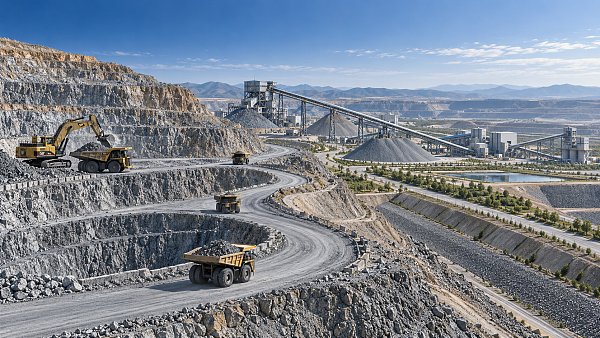
Consider a plan that assumes a certain truck payload, availability level, and cycle time. On paper, the fleet size may support the production target. In practice, ramp gradients, road quality, weather exposure, loading compatibility, maintenance access, tire availability, fuel strategy, and operator or autonomous-system constraints can all reduce effective output. A planning model does not need every uncertainty removed. It needs uncertainties identified, ranked, and connected to decisions that can still be changed.
The same pattern appears in processing. A recovery estimate may be technically plausible, yet the operating consequence may depend on hardness variation, moisture, clay content, water chemistry, reagent supply, tailings behavior, or concentrate transport limits. If these variables are treated separately by geology, metallurgy, engineering, and commercial teams, the plan can remain internally inconsistent while each individual workstream appears reasonable.
Intelligence should challenge assumptions, not decorate reports
The most useful intelligence work starts with a decision that has a real consequence. “Understand the market” is too broad to guide a mine plan. A stronger question is: “Can the selected primary loading and haulage configuration maintain the required material movement across the anticipated duty cycle?” Another is: “What changes to the plant layout would be justified if ore variability requires more blending capacity?”
Once the decision is clear, the team can specify what must be known, what can be estimated, and what must remain a contingency. This changes intelligence from a collection exercise into a planning control.
- Technical intelligence tests equipment capability, compatibility, maintainability, energy use, throughput limits, material handling behavior, and performance under comparable operating conditions.
- Commercial intelligence examines supplier capacity, tender activity, replacement-part exposure, lead-time sensitivity, contractor availability, and procurement concentration.
- Market intelligence provides context for commodity-price scenarios, treatment and transport pressures, project activity, and competing demand for critical equipment or services.
- Regulatory and ESG intelligence identifies permitting dependencies, safety obligations, water and land-use constraints, emissions requirements, closure expectations, and reporting risks that can affect mine design.
These categories should not be reviewed in isolation. A choice to electrify a mobile fleet, for example, is not only an emissions decision. It affects mine layout, charging or power distribution, maintenance capability, operating schedule, energy reliability, equipment availability assumptions, and potentially the construction sequence. Intelligence improves the decision only when those interfaces are made explicit.
Use planning gates to ask different questions at different levels of certainty
A common mistake is to apply the same depth of review throughout a project. Early options need broad screening and clear exclusion logic. Later design stages need narrower, better-evidenced comparisons. Mining intelligence services become more valuable when their output changes with the maturity of the decision.
At the concept stage, comparative benchmarks can reveal whether an option deserves further engineering. The objective is not to prove a final selection; it is to avoid spending design effort on alternatives with poor operational fit. At feasibility stage, the emphasis shifts toward evidence quality. A plan should distinguish between vendor-stated capability, benchmarked operating performance, site-specific test results, and assumptions still awaiting confirmation.
Turn external signals into mine-plan inputs
Intelligence often fails to influence decisions because it arrives as a separate market brief, technical note, or risk register. Planning improves when key findings are translated into variables that can be tested in schedules, designs, and financial models.
For equipment, this may mean replacing a single availability assumption with a range tied to maintenance strategy, ambient conditions, fleet size, parts exposure, and workshop capacity. For bulk materials handling, it may mean testing conveyor, crusher, stockpile, and transfer-point design against moisture variation, particle-size distribution, dust controls, and expected downtime. For mineral processing, it may mean defining ore-domain scenarios rather than relying on an average feed characteristic that rarely occurs for long in operation.
Not every finding needs to be embedded as a numerical parameter. Some intelligence should become a design condition or management action. A known long lead time for a major component may require an earlier procurement decision. A regulatory uncertainty may require two layouts or water-management strategies to remain viable until an approval path is clearer. Evidence of constrained skilled-labor availability may influence the degree of modularization, maintenance contract structure, or commissioning sequence.
Separate facts, estimates, and decisions
One practical discipline is to maintain an assumption register that does more than list inputs. Each critical item should identify its source, confidence level, owner, planning consequence, and the date or event that will trigger review. This is especially important when technical and commercial evidence point in different directions.
For example, a machine may meet the required nominal payload but have limited evidence of sustained performance in the intended duty cycle. The appropriate response is not automatically rejection. It may be to preserve an alternative fleet configuration, conduct a compatibility review, revise the maintenance allowance, or set a procurement condition requiring further validation. The plan becomes more robust because uncertainty is managed openly rather than hidden inside an average value.
Equipment selection needs a lifecycle view
Mine plans frequently focus on acquisition cost and rated capacity because both are easy to compare. Yet a fleet or plant component changes the project economics through availability, serviceability, energy use, consumables, operator requirements, spares strategy, rebuild intervals, and the consequences of a single point of failure. These factors influence the physical plan as much as the operating budget.
A useful equipment review asks whether the asset fits the system around it. An excavator, loader, drill rig, crusher, pump, or conveyor should not be assessed only as an individual machine. Check loading-tool and truck matching, dump geometry, fragmentation range, road conditions, power quality, workshop access, component lifting needs, and maintenance windows. A high-capacity unit can create a bottleneck elsewhere if downstream handling, stockpile management, or service infrastructure cannot support it.
Autonomous and low-emission equipment adds further interfaces. The decision may affect communications coverage, traffic separation, energy supply, emergency response, change management, and data governance. Planning intelligence should therefore test implementation conditions, not just headline technical features. A technology that performs well in one operating environment may require substantial redesign in another.
Commodity and tender signals are most useful when linked to timing
Commodity outlooks should not be used to justify a preferred plan after the fact. Their practical role is to test the resilience of sequencing and capital commitments. A mine schedule built around a narrow price assumption may leave little room to defer a high-strip phase, change stockpiling priorities, protect cash flow, or preserve ore optionality. Intelligence can help the team identify where flexibility has value, such as staged capacity additions, alternative cutback timing, stockpile segregation, or modular infrastructure.
Tender activity and regional project pipelines also matter because they affect the availability of equipment, construction resources, processing packages, transport capacity, and specialist contractors. When several projects compete for similar capabilities, a schedule based on standard lead times may be unreliable. The correct planning response may be early market engagement, specification simplification, alternate supplier qualification, or a changed construction sequence. It should not be a vague note that supply-chain risk exists.
Build a decision record that can survive challenge
Planning decisions are often revisited months later, after a change in geology, market conditions, engineering maturity, or leadership. A decision record should make clear why an option was selected and what evidence would cause the team to reconsider it. This is more valuable than a long narrative report that does not reveal the assumptions behind the recommendation.
For material decisions, document the alternatives considered, non-negotiable constraints, critical evidence, unresolved uncertainties, downside exposure, and required follow-up actions. Also identify whether the decision is reversible. A reversible choice can be made with a different evidence threshold than one that locks in mine geometry, plant configuration, power infrastructure, or tailings arrangements for years.
Decision records also improve cross-functional alignment. Geology may accept a different level of ore uncertainty than metallurgy; procurement may see a supply risk that engineering has not modeled; site operations may identify a maintenance or access issue invisible in desktop design. A structured review forces those views into the same decision space.
Warning signs that intelligence is not improving the plan
Several patterns indicate that information is being gathered without changing decision quality. One is a growing number of reports paired with unchanged assumptions. Another is the repeated use of industry averages where the site has unusual geometry, material characteristics, climate, infrastructure limitations, or regulatory exposure. A third is treating supplier claims, preliminary test results, and proven operating data as if they carry the same confidence.
There is also a governance warning sign: intelligence is discussed only in periodic updates rather than at the moment a design, procurement, or sequencing choice must be made. By the time a risk is presented as a general observation, the affected package may already be too advanced to adjust economically.
The stronger approach is to connect each significant finding to one of four outcomes: retain the current assumption, revise the model input, investigate further before commitment, or redesign the decision pathway. This makes the value of mining intelligence services visible in practical terms. The aim is not perfect prediction. It is a mine plan that exposes its dependencies early enough for the team to respond with better engineering, more realistic schedules, and choices that remain workable when conditions change.
Recommended News
 Oct 06, 2026When mining intelligence services improve mine planning decisionsMining intelligence services help teams challenge assumptions, reduce supply and ESG risks, and build resilient mine plans with stronger equipment, processing, and scheduling decisions.
 Oct 05, 2026When do digital signage solutions improve safety alerts at mine sites?Digital signage solutions improve mine safety alerts with timely, location-specific warnings for blasting, haul roads, weather, and restricted access.
 Oct 01, 2026What to assess in a mining technology provider for digital mine projectsMining technology provider selection made practical: assess integration, data ownership, cybersecurity, field reliability, lifecycle support, and measurable digital mine value.
 Sep 22, 2026When life sciences need a mine digital twin to improve planningLife sciences leaders can use a mine digital twin approach to test facility constraints, reduce lifecycle risk, and make smarter capital planning decisions.